Robert Andrison
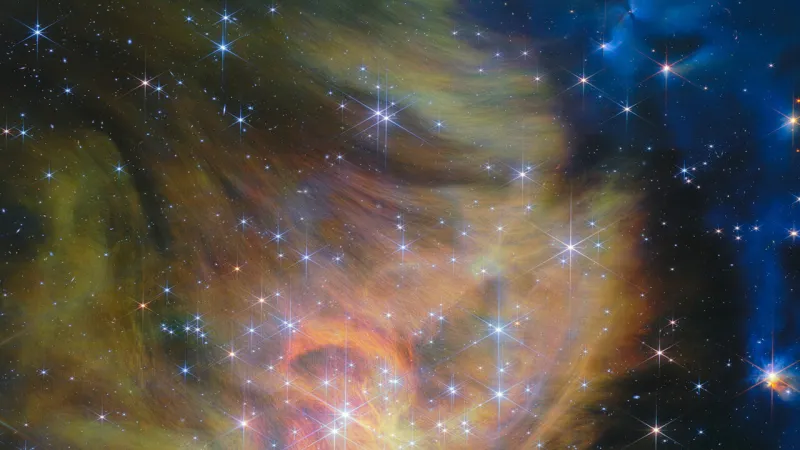
WASHINGTON – Scientists utilizing the advanced capabilities of the James Webb Space Telescope have recently announced the groundbreaking detection of the smallest brown dwarfs ever observed, celestial objects each roughly twice the mass of Jupiter. This significant finding, made possible by the telescopes unparalleled infrared vision, offers critical new insights into the elusive boundary between planets and stars, further refining our understanding of cosmic formation processes.
The discovery marks a pivotal moment in astrophysics, pushing the limits of what telescopes can detect in the cold, dark reaches of space. Brown dwarfs, often termed “failed stars,” are fascinating entities that occupy a unique niche, being too massive to be considered planets yet lacking sufficient mass to sustain the nuclear fusion reactions characteristic of true stars like our sun.
Previously, identifying these dim, cold objects proved exceedingly challenging. Their inherent lack of luminosity makes them almost invisible to traditional optical telescopes. However, the James Webb Space Telescope, with its primary mirror nearly seven times larger than Hubbles and optimized for infrared observation, can pierce through cosmic dust and detect the faint heat signatures emitted by these distant bodies.
Researchers focused on specific regions of star formation, where conditions are prime for the birth of both stars and substellar objects. The infrared spectrum is particularly crucial because brown dwarfs, despite not burning hydrogen like stars, still emit a residual heat from their gravitational contraction, which is best observed at these wavelengths.
The newly identified brown dwarfs are remarkable for their diminutive size relative to others previously cataloged. Measuring approximately twice the mass of Jupiter places them at the very lowest end of the brown dwarf mass spectrum, verging on the upper limits of what constitutes a gas giant planet.
This observation challenges existing theoretical models of how these substellar objects form. Astronomers have long debated whether brown dwarfs form like stars, through the collapse of gas clouds, or more akin to planets, via core accretion within protoplanetary disks. These new discoveries provide empirical data to test these competing hypotheses.
The detailed spectroscopic data collected by JWST on these objects will allow scientists to analyze their atmospheric compositions and temperatures, offering clues about their age and formation environment. Such analysis is crucial for understanding the diversity of exoplanetary systems and the prevalence of these in-between objects in our galaxy.
“These smallest brown dwarfs represent a crucial missing link in our cosmic understanding,” stated Dr. Elena Petrova, lead researcher on the project, in a recent press briefing. “Their detection with JWST confirms our models are progressing, yet also opens new avenues for inquiry into how matter organizes itself across the universe.”
The James Webb Space Telescope continues to redefine the boundaries of astronomical exploration since its launch. From imaging the earliest galaxies to characterizing exoplanet atmospheres, its instruments consistently deliver unprecedented views of the cosmos, furthering humanitys quest to comprehend its place within it.
Future studies will likely involve searching for more such low-mass brown dwarfs in various star-forming regions and open clusters. The goal is to establish a more complete census of these objects, which could potentially outnumber true stars in certain parts of the galaxy, influencing our galaxys mass distribution and evolution.
Understanding the precise conditions under which objects transition from massive gas giants to failed stars is fundamental. It sheds light on the universal laws governing stellar and planetary birth, illustrating the remarkable versatility of gravitational forces in shaping celestial bodies.
This groundbreaking work underscores the profound scientific returns on investment in advanced space observatories. As JWST continues its mission, more such surprising discoveries are anticipated, each contributing to a richer, more nuanced picture of the universe around us.