 Chris Robert
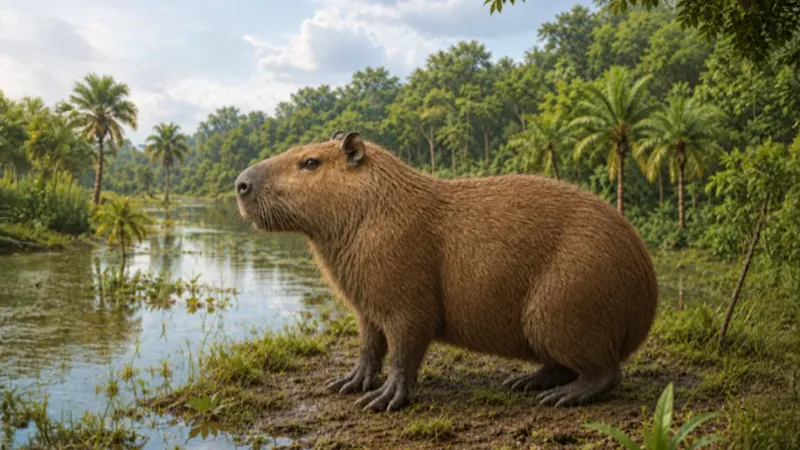
BANGKOK – Paleontologists in Thailand have announced the discovery of an exceptionally large fossilized rodent, named Yakamys sirindhornae, which roamed the Earth approximately 34 million years ago. This monumental find, detailed in a recent scientific publication, significantly reconfigures established timelines for the evolution of colossal rodents, indicating that these enormous creatures emerged far earlier than previously understood.
The unearthed remains suggest this ancient animal tipped the scales at an estimated 66 pounds, making it roughly twice the mass of other known rodent species from its epoch. The fossil collection was meticulously excavated from deposits in what is now modern-day Thailand, providing critical insights into mammalian biodiversity during the late Eocene and early Oligocene periods.
The revelation of Yakamys sirindhornae challenges prevailing scientific paradigms that posited the evolution of extremely large rodents as a more recent phenomenon, largely occurring after major climatic shifts or specific ecological opportunities. Its existence 34 million years ago indicates a greater adaptive capacity for gigantism within rodent lineages at an earlier stage of their evolutionary history.
To put its size into perspective, a 66-pound rodent would dwarf even the largest living rodents today, such as the capybara, which typically weighs between 77 and 140 pounds. While not as heavy as a capybara, Yakamys sirindhornae represents a remarkable benchmark for prehistoric rodent dimensions, pushing the boundaries of what was thought possible for the group during that ancient era.
The scientific name, Yakamys sirindhornae, honors Her Royal Highness Princess Maha Chakri Sirindhorn of Thailand, recognizing her profound contributions to scientific research and conservation within the kingdom. Such naming conventions often celebrate individuals who foster scientific inquiry and exploration.
The geological stratum where the fossils were discovered corresponds to a period marked by significant global environmental changes, including cooling temperatures and the expansion of open grasslands. Understanding the habitat and ecological niche of this giant rodent could offer clues into how it thrived amid these transformations.
Researchers employed advanced paleontological techniques to carefully extract and analyze the delicate fossil fragments. Detailed morphological comparisons with other known rodent fossils, alongside radiometric dating, allowed scientists to precisely determine the species age and its place within the broader mammalian phylogenetic tree.
This discovery fuels ongoing debates among paleontologists regarding the drivers of body size evolution in mammals. It suggests that ecological pressures or abundant food resources in specific regions may have facilitated the early emergence of gigantism, providing a richer tapestry of ancient life than previously envisioned.
Future studies will likely focus on finding more complete skeletal remains of Yakamys sirindhornae to reconstruct its full anatomy, understand its locomotion, and infer its diet. Such investigations will further illuminate the environmental conditions and interspecies dynamics that permitted such large rodents to flourish.
The identification of this ancient giant rodent not only reshapes evolutionary narratives but also underscores Thailand's rich paleontological heritage. It reinforces the importance of continued exploration in lesser-studied regions, which often hold untold secrets about Earth's distant past and the incredible diversity of life it once harbored.