 Chandra Wijayanto
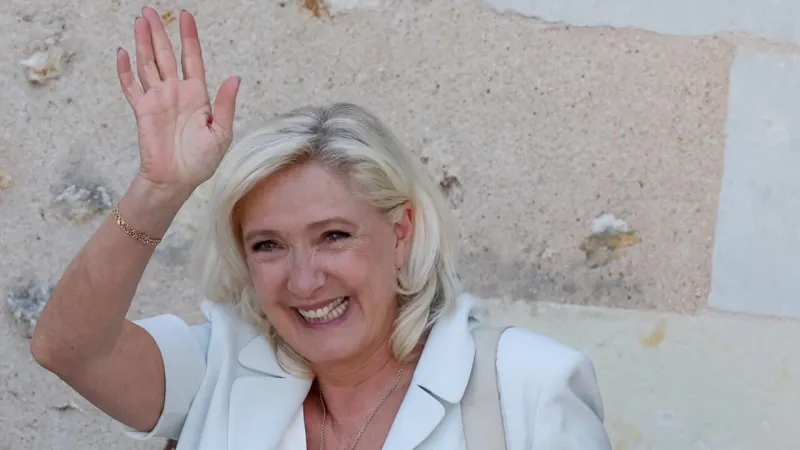
The Paris political landscape reverberated this week as Marine Le Pen, leader of France's Rassemblement National (RN), unveiled a new strategic maneuver, igniting a fervent internal debate and raising questions about the party's future direction. This audacious step, widely interpreted as a bid to broaden the party's electoral appeal, has met with swift criticism from various factions within the deeply entrenched far-right movement, prompting its rising star, Jordan Bardella, to openly express his reservations.
Bardella, often seen as Le Pen's designated successor and the public face of the RN among younger voters, has entered a period of intense deliberation, carefully scrutinizing the implications of the leader's bold proposal. Sources close to the party indicate that Bardella's hesitation stems from concerns that the new strategy might compromise the RN's core identity or alienate its traditional voter base. His cautious approach underscores the significant internal divisions now surfacing within the party.
The specific details of Le Pen's initiative, while not fully disclosed to the public, are understood to involve a realignment of the party's electoral approach, possibly encompassing outreach to other conservative or nationalist groupings. This move aims to consolidate a broader right-wing bloc ahead of crucial future elections, a long-standing aspiration for Le Pen but one historically fraught with challenges and internal resistance.
Critics within the RN argue that such a strategy risks diluting the party's distinct anti-establishment and nationalist message, a cornerstone of its appeal. They contend that any significant departure from this ideological purity could lead to a loss of authenticity, thereby undermining the very support Le Pen seeks to expand. The debate highlights a perennial tension within the French far-right between ideological integrity and electoral pragmatism.
The controversy also brings to the forefront the delicate power dynamics between Le Pen and Bardella. Le Pen, a seasoned political figure who has transformed the party from its Front National roots, has consistently sought to mainstream its image. Bardella, having successfully led the RN in recent European parliamentary elections, carries significant political capital and represents a potentially more pragmatic and media-savvy generation within the party.
Observers suggest that Bardella's public contemplation of Le Pen's move is not merely a personal reflection but a strategic calculation. His eventual stance could either solidify Le Pen's leadership by endorsement or significantly challenge her authority, potentially triggering a wider shake-up within the RN ahead of critical national contests. The term dauphin studying his next move is frequently used by those monitoring the party's internal machinations.
The broader French political spectrum watches these developments keenly. Centrist and left-wing parties hope the internal strife within the RN will weaken its formidable electoral challenge. Historically, divisions within the far-right have often hampered its ability to form cohesive majorities or broad alliances, a pattern Le Pen has actively sought to break.
Le Pen's ambition to unify nationalist and conservative forces under a single banner echoes past attempts by figures across Europe to forge powerful right-wing coalitions. However, the path is often complicated by differing ideological nuances and personal rivalries, as seen in various European nations where similar endeavors have yielded mixed results.
The current debate also reflects the evolving nature of European populism, where traditional party lines blur, and leaders constantly search for new ways to consolidate power. The Rassemblement National, under Le Pen's leadership, has consistently adapted its messaging, shifting from outright anti-European Union rhetoric to a more nuanced critique, while maintaining its core focus on national sovereignty and identity.
As France navigates a complex political period, the choices made by Marine Le Pen and Jordan Bardella will undoubtedly shape the trajectory of the Rassemblement National and, by extension, the future of French politics. The coming weeks are expected to reveal whether Le Pen's latest gambit ultimately unifies or fragments the far-right movement she has painstakingly built.