 Dorry Archiles
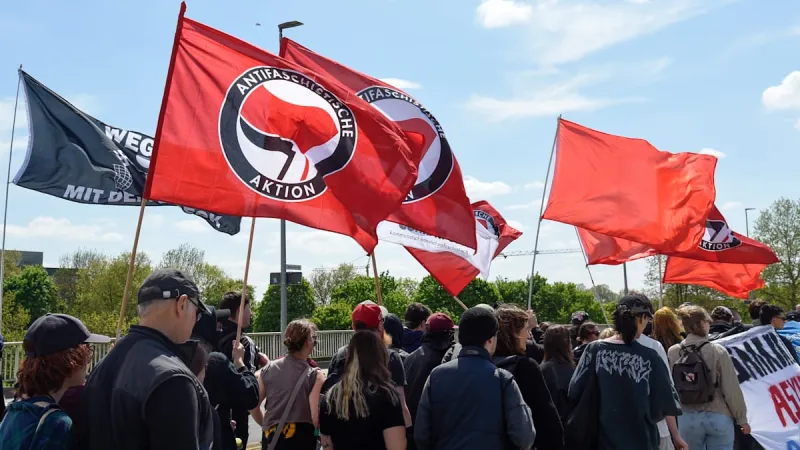
A leading European law expert, Volker Boehme-Nessler, has unequivocally stated that certain forms of public protest, specifically street blockades, transcend the boundaries of peaceful demonstration and should be classified as criminal offenses. His remarks arrive amidst heightened concerns over the escalating nature of political activism and perceived attempts by various groups to introduce political violence into public spaces.
Boehme-Nessler, an esteemed authority on European law, detailed his legal analysis by distinguishing between constitutionally protected assembly and actions that deliberately impede public order and safety. He underscored that while the right to protest is fundamental, it is not without legal limitations.
“Blockading constitutes a criminal offense and not a peaceful demonstration,” Boehme-Nessler declared, offering a stark legal interpretation that challenges the widely held perception of all protest actions as inherently peaceful or legally permissible.
His statements resonate with a growing sentiment among legal scholars and political figures who are calling for a clearer demarcation between legitimate dissent and unlawful obstruction. The expert noted a concerning trend where certain organizations are deliberately pushing the envelope, transforming protests into confrontational acts.
This legal perspective sheds light on the intricacies of demonstration laws, particularly in the European context, where the balance between individual freedoms and collective societal order is constantly being negotiated. The legal scholar’s insights suggest that the intent and impact of a protest are crucial in determining its legality.
Traditional forms of peaceful demonstration, such as marches, rallies, and public speeches, aim to raise awareness and influence public opinion without infringing upon the rights of others or causing widespread disruption. Blockades, by their very nature, are designed to disrupt, often leading to significant economic and social consequences.
The implications of Boehme-Nessler's analysis are far-reaching, potentially influencing how law enforcement agencies respond to future demonstrations and how courts adjudicate cases involving protest-related offenses. It emphasizes the need for a nuanced understanding of protest dynamics in a complex society.
Other prominent voices have echoed similar sentiments regarding the criminal nature of such disruptive tactics. Wolfgang Kubicki, a German political leader, previously denounced similar blockades, labeling the participants as criminals. His remarks, like Boehme-Nessler's, highlight a judicial and political willingness to crack down on actions deemed illegal. For more, read Kubicki Denounces AfD Congress Blockades, Labels Protesters Criminals.
Furthermore, broader warnings about the orchestration of civil unrest have been raised by commentators such as Henryk M. Broder, who specifically cautioned about groups attempting to foment disorder. These concerns underscore a prevailing apprehension about the integrity of public demonstrations. Details can be found in Broder Warns: Antifa Orchestrates Civil Unrest Ahead of AfD Congress.
The legal framework for demonstrations across various European nations typically includes provisions for maintaining public order, ensuring safety, and preventing damage to property. Boehme-Nessler's interpretation suggests that blockades often transgress these established legal boundaries, irrespective of the stated motivations of the protestors.
This ongoing debate compels a critical examination of the methods employed in political activism. As nations navigate an increasingly polarized political landscape, the distinction between legitimate protest and unlawful conduct becomes paramount for upholding both individual liberties and the rule of law.
Ultimately, Boehme-Nessler’s authoritative stance reinforces the argument that while freedom of expression is a cornerstone of democratic societies, it does not grant impunity for actions that constitute criminal offenses or deliberately destabilize public life. The conversation continues to evolve on how societies can protect the right to protest while effectively addressing politically motivated disruptions.