Gabriella
ÉVIAN, France – President Donald Trump has exhibited a surprising willingness to adopt a more stringent posture toward Russia during the recent G7 summit in Évian, a development observers attribute to the astute diplomatic overtures of French President Emmanuel Macron and German opposition leader Friedrich Merz. This significant shift is widely interpreted as a potential, albeit possibly transient, victory for Ukraine amid ongoing geopolitical tensions.
The unexpected turn by President Trump, who has previously advocated for more conciliatory engagement with Moscow, marks a notable divergence from his historical rhetoric. Analysts suggest that the carefully calibrated discussions and persuasive tactics employed by Macron and Merz played a pivotal role in this reorientation of policy.
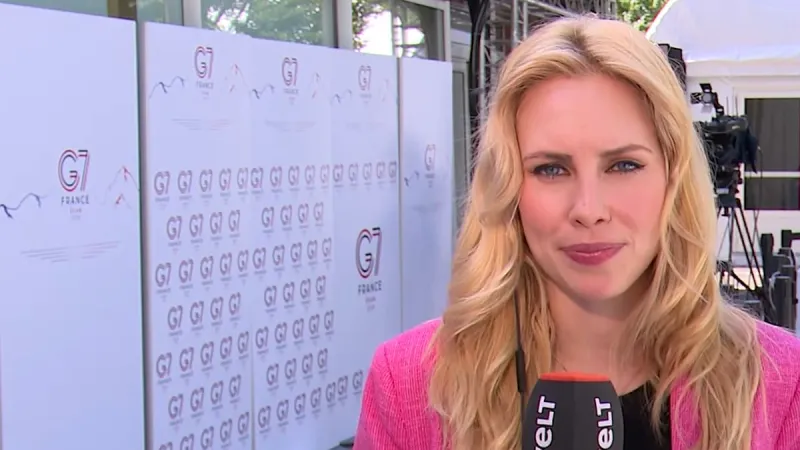
WELT-reporter Dorothea Schupelius observed that while the immediate outcome represents a success for Ukraine, the durability of President Trump's newfound resolve remains an open question. The long-term implications of this G7 consensus for Eastern European stability are therefore still subject to careful monitoring.
For Ukraine, any indication of a stronger, unified front against Russian aggression from the world's leading industrial nations is a welcome development. Kyiv has consistently sought greater international support and more robust measures to deter further incursions into its sovereign territory.
The G7 summit, traditionally a platform for coordinating global economic and security policies, served as a crucial stage for these high-stakes diplomatic exchanges. Leaders from Canada, France, Germany, Italy, Japan, the United Kingdom, and the United States converged to address pressing international issues.
Discussions surrounding Russia's actions, particularly in light of ongoing conflicts and geopolitical maneuvers, dominated a significant portion of the summit's agenda. The consensus among G7 members to challenge Moscow more directly represents a consolidated stance against perceived destabilizing activities.
Previous G7 gatherings have also seen robust debate over Russia. At a prior summit, G7 leaders threatened Russia with sanctions, and President Trump at the time demanded a Putin agreement, underscoring the persistent challenges in formulating a cohesive Western policy toward Moscow.
The specific mechanisms through which Macron and Merz influenced President Trump's thinking are not yet fully detailed, but sources close to the delegations indicated a strategy emphasizing shared democratic values and the imperative of collective security in Europe. Their approach appears to have focused on presenting a unified narrative regarding the strategic threats posed by an unchecked Russia.
President Macron has consistently positioned France as a key player in European security, often engaging in direct diplomacy with various global leaders. His proactive stance at the G7 likely reinforced the collective desire for a stronger position against Moscow.
Similarly, Friedrich Merz, a prominent figure in German politics, has advocated for a more assertive German foreign policy, particularly concerning Russia. His influence at the G7, even as an opposition leader, underscores the depth of bipartisan concern regarding Russian actions within the European political landscape.
The G7's collective commitment to a harder line could manifest in various forms, including expanded sanctions, increased military aid to Ukraine, or enhanced diplomatic isolation of Russia on the international stage. The exact implementation of these measures will be critical in determining their ultimate effectiveness.
However, the question of sustained commitment from President Trump remains paramount. Historical patterns suggest a propensity for shifting positions, making the long-term enforcement of any G7 consensus on Russia contingent on continued diplomatic pressure and evolving geopolitical circumstances.
Ukrainian officials, while cautiously optimistic, are likely to observe closely for tangible policy changes and consistent support from Washington. The symbolic importance of the G7's declaration is undeniable, but practical application is where the true test lies.
This diplomatic development at Évian adds a new dimension to the complex relationship between the West and Russia, potentially recalibrating the strategic calculus for all parties involved. The world now watches to see if this shift translates into enduring policy and a more secure future for Ukraine.