Gabriella
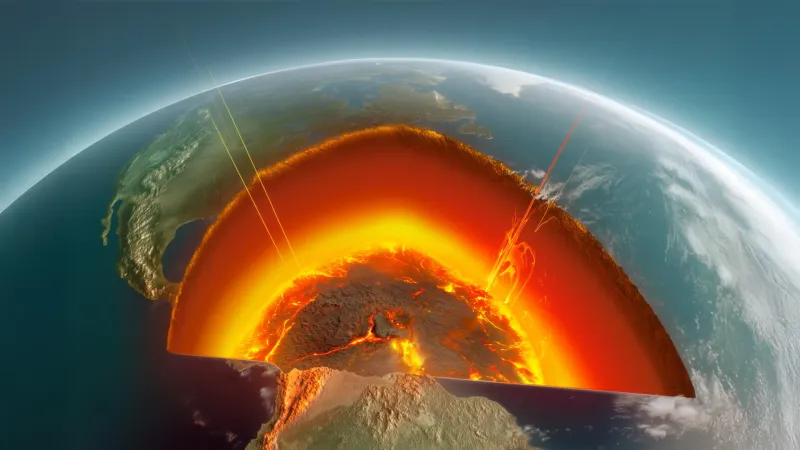
Scientists have unearthed a groundbreaking discovery deep within Earths interior, revealing that magma can store substantial quantities of oxygen. This finding, published recently, fundamentally challenges existing theories about how our planet developed its life-sustaining, oxygen-rich atmosphere billions of years ago, offering crucial insights into planetary evolution and the potential for life beyond Earth.
The research indicates that these subterranean reservoirs could have played a far more significant role than previously understood in shaping the air we breathe. Traditionally, the rise of atmospheric oxygen has been primarily attributed to photosynthetic organisms, yet this new evidence points to a powerful geological contributor.
Researchers identified that under immense pressure and temperature, silicate melts, the primary component of magma, possess a remarkable capacity to dissolve and retain oxygen atoms. This process effectively sequesters vast amounts of oxygen beneath the Earths crust.
The sheer scale of this newly recognized oxygen cache is staggering. Estimates suggest that the deep Earth could hold oxygen equivalent to several times the total amount currently present in the atmosphere, representing a significant planetary resource.
Such a substantial reservoir implies that ancient volcanic eruptions, which brought magma to the surface, may have periodically released bursts of oxygen into the primordial atmosphere. This mechanism could have profoundly influenced early atmospheric composition long before biological processes became dominant.
The study provides a compelling geological pathway for the enrichment of Earths atmosphere with oxygen, offering a complementary explanation to the well-established biological theories. Understanding this dual contribution is pivotal for a comprehensive view of our planets environmental history.
The scientists utilized advanced experimental techniques, replicating the extreme conditions found deep within Earths mantle in specialized laboratories. By subjecting mineral samples to these conditions, they observed and quantified the unexpected oxygen storage capabilities of magma.
This revelation extends beyond Earths past. For astrobiologists, the existence of a deep-seated oxygen source on other rocky planets could drastically alter calculations for habitability. A planet might harbor the building blocks for an oxygenated atmosphere without necessarily relying solely on surface biology.
The discovery also underscores the complex interplay between Earths interior dynamics and its surface environment. Volcanic activity, driven by internal heat, is not merely a geological event but a critical factor in shaping atmospheric chemistry and, by extension, the conditions for life.
Future investigations will likely focus on quantifying the rates of oxygen release from magma during various volcanic events throughout geological time. Pinpointing when and how much oxygen escaped these deep reservoirs will refine models of early Earth and its atmospheric development.
The planet's ability to maintain a stable, oxygen-rich environment is crucial for complex life. This research adds another layer to our understanding of the delicate balance that has allowed life to flourish for billions of years.
While the prevailing scientific consensus attributes the Great Oxidation Event, a period when atmospheric oxygen significantly increased, primarily to cyanobacteria, this new research suggests a reevaluation of geological contributions during earlier stages.
This breakthrough promises to stimulate new avenues of research in geochemistry, geophysics, and atmospheric science, pushing scientists to reconsider the deep Earths role as an active participant in global biogeochemical cycles.
Ultimately, the findings could influence how astronomers and planetary scientists prioritize exoplanet targets for signs of life. The presence of active geology and volcanism might be a more potent indicator of potential oxygenated atmospheres than previously thought.