 Debby Wijaya
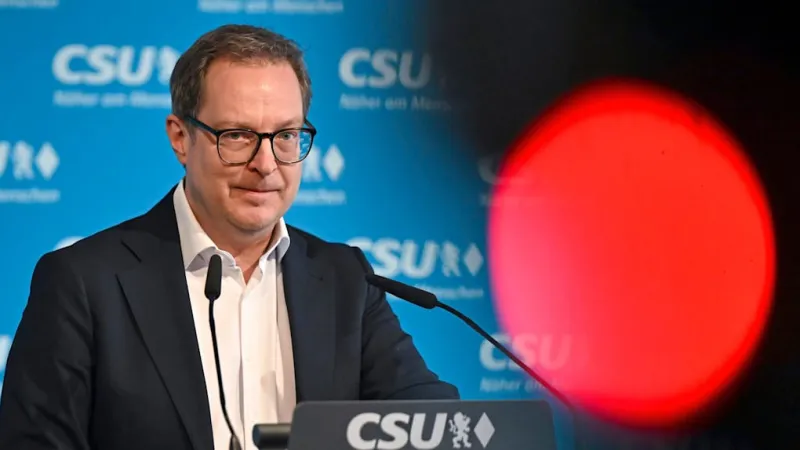
Berlin – CSU General Secretary Martin Huber has firmly defended the proposed extremism clause, a measure intended to safeguard democratic principles, while simultaneously launching a critique against Germany's state financial equalization system. This dual stance underscores the conservative party's commitment to both ideological purity and fiscal reform, as it unequivocally rejects potential government alliances with either the far-right Alternative for Germany (AfD) or the left-wing Die Linke party.
Huber's advocacy for the extremism clause comes amid ongoing political discourse surrounding the integrity of Germany's democratic institutions. He robustly pushed back against critics, asserting the necessity of such a policy to ensure that public funds and political partnerships align strictly with constitutional values. The clause, still a concept under debate, aims to prevent individuals or organizations deemed extremist from benefiting from state resources or holding influence in governmental structures.
The General Secretary explicitly stated the CSU's refusal to consider any governing coalitions that would include either the AfD or Die Linke. This clear demarcation highlights the party's strategic positioning within the German political landscape, drawing a line against parties perceived to operate at the fringes of mainstream democratic consensus, from both the extreme right and extreme left.
The rationale behind an extremism clause is rooted in Germany's historical commitment to a wehrhafte Demokratie, or defensive democracy, which allows the state to actively protect its constitutional order from those who seek to undermine it. Proponents argue it provides a necessary tool to filter out anti-democratic influences from public life and government formation.
Beyond ideological fortifications, Huber also turned his attention to economic policy, voicing strong objections to the current mechanism of state financial equalization, known as Länderfinanzausgleich. He argued that the present system unfairly burdens economically stronger states, diverting funds without sufficient accountability or incentive for recipient states to enhance their own fiscal independence.
The Länderfinanzausgleich is a complex system designed to ensure relatively uniform living conditions across Germany's 16 federal states by redistributing tax revenues from wealthier states to those with lower fiscal capacities. While intended to foster solidarity and balance, it frequently becomes a flashpoint for debate, with contributing states often feeling disproportionately burdened.
The CSU's firm positions on both ideological and fiscal matters emerge as Germany's political environment remains dynamic. Discussions surrounding coalition possibilities and inter-party power dynamics are always prevalent, as seen in the broader context of federal politics, which recently highlighted an SPD Power Struggle Looms: Germany's Ruling Party Faces Pivotal Leadership Battle. These internal party struggles and policy debates collectively shape the nation's governance.
Huber's declarations are not merely rhetorical; they signal potential obstacles for future government formation at both federal and state levels. By pre-emptively ruling out partnerships with significant parliamentary blocs, the CSU influences the strategic calculations of other parties aiming to forge stable majorities.
The General Secretary's assertions are likely to elicit varied responses across the political spectrum. While centrist parties might appreciate the reinforcement of democratic boundaries, those targeted by the coalition exclusion or fiscal criticism will undoubtedly voice strong opposition, intensifying the ongoing national dialogue on these pivotal issues.
Germany has a sensitive history concerning political extremism, fostering a robust legal framework to protect its democratic foundation. Debates over measures like the extremism clause reflect this vigilance, seeking to prevent the rise of ideologies that challenge the constitutional order, echoing lessons from its 20th-century past.
Economists and policymakers often engage in spirited discussions about the efficacy and fairness of the Länderfinanzausgleich. Critics, like Huber, frequently cite a perceived lack of incentive for economic growth in recipient states, arguing for reforms that promote greater fiscal autonomy and competition among the federal entities.
For the CSU, a regional party primarily strong in Bavaria but a crucial partner in federal coalitions, these pronouncements serve to solidify its conservative identity and appeal to its core electorate. They underscore a commitment to stability, both ideologically and financially, projecting an image of steadfast leadership.
Forming stable governments in Germany's multi-party system often requires complex negotiations and compromises. The CSU's definitive rejection of specific partners complicates this process, potentially narrowing pathways to viable majorities and emphasizing the critical role of centrist alliances.
As General Secretary, Martin Huber plays a key role in articulating the CSU's strategic direction and public messaging. His statements reflect not only the party's current policy positions but also its long-term vision for Germany's political and economic future, signaling robust engagement in national debates.
These contentious issues—protecting democracy from extremism and reforming fiscal federalism—will undoubtedly remain central to Germany's political discourse in the coming months and years. The CSU's proactive stance ensures these debates will continue with renewed vigor, shaping the nation's trajectory in 2026 and beyond.