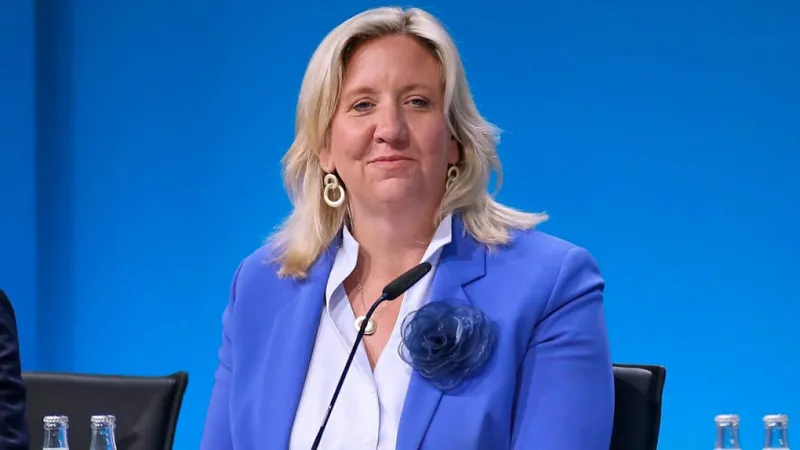
 Angela Stefani
BERLIN – A brewing personal debate over the potential succession of President Frank-Walter Steinmeier has seen Ines Claus, a prominent CDU politician from Hessen, emerge as a candidate with reported backing from party chairman Friedrich Merz. This early maneuvering signals a potential point of contention within Germany's conservative alliance, particularly with its Bavarian sister party, the CSU.
The development marks an assertive move by the CDU to shape the future leadership of the largely ceremonial yet symbolically powerful head of state. President Steinmeier's term is approaching its conclusion, prompting a premature but crucial discussion about who will occupy Bellevue Palace next.
Ines Claus, a member of the Hessen state parliament, has reportedly expressed interest in the role, a move that would elevate her from regional politics to the national stage. Her political trajectory within the CDU has been marked by a steadfast commitment to the party's principles and a growing profile in the party's younger guard.
Friedrich Merz's reported endorsement of Claus is particularly noteworthy. As the leader of the Christian Democratic Union, his backing provides significant momentum and indicates a clear preference from the party's top echelon. This support could be interpreted as a strategic effort to consolidate influence over the presidential selection process.
However, this strategic alignment immediately raises questions regarding the traditional partnership between the CDU and its Bavarian counterpart, the Christian Social Union. The CSU historically plays a key role in national elections and, by extension, in the selection of presidential candidates, often seeking to present a united front or propose its own figure for high office.
The prospect of Merz's unilateral support for a CDU candidate without apparent prior consensus with the CSU could trigger significant internal strife. Historically, the two parties have navigated such appointments through careful negotiation and compromise to avoid public discord, which could weaken the conservative bloc.
Germany's presidency, while not holding executive power, serves as a crucial moral compass and embodies national unity. The election is conducted by the Federal Convention, a body comprising members of the Bundestag and an equal number of delegates chosen by the state parliaments. The selection process is a complex interplay of political will and regional representation.
Observers recall past instances of tension between the CDU and CSU over key personnel decisions, where divergent interests threatened to unravel their parliamentary alliance. This emerging debate over the Steinmeier succession could revive old fault lines, challenging the fragile unity within the center-right.
Merz's decision to champion Claus could also be interpreted as a move to assert CDU dominance in national political appointments, potentially pre-empting any CSU-led initiatives. Such a bold step highlights the evolving dynamics within the conservative camp as it navigates the complexities of the current political landscape.
The broader implications extend beyond merely selecting a president. A public disagreement between the CDU and CSU over this issue could distract from other pressing national concerns, such as economic reforms or social policies. The CDU, for example, has recently voiced concerns about the direction of the current government, articulating positions on fiscal matters and security that underscore the urgency of internal coherence. For instance, the CDU has warned against potential tax hikes and security risks, emphasizing the need for a stable political foundation.
Furthermore, the debate over presidential succession comes at a time when German politics faces numerous challenges, including budgetary pressures and international obligations. The ability of the conservative parties to present a united front is often seen as a barometer of their overall strength and readiness for leadership.
The emergence of Ines Claus as a front-runner, supported by Merz, may also reflect a desire within the CDU for a fresh face and a younger perspective in high office. This push for renewal could be a response to internal critiques or a strategic effort to appeal to a broader electorate.
Conversely, the CSU might view this move as a slight, potentially leading them to either present their own candidate or demand significant concessions in other areas of national policy. The historical power-sharing agreement between the two parties rests on mutual respect and consultation.
The potential for a dispute underscores the delicate balance required to maintain the CDU-CSU alliance, a cornerstone of conservative politics in Germany. Any significant rupture could have repercussions for future coalition formations and electoral strategies.
As the political calendar progresses toward the eventual election of President Steinmeier's successor, the actions and reactions of both the CDU and CSU will be closely watched. Their ability to manage this internal debate without fracturing their alliance will be a key test of their leadership.
The coming months will undoubtedly reveal whether this early declaration of interest and prominent backing leads to a consensual decision or ignites a more profound intra-conservative struggle. The outcome will shape not only the presidential office but also the broader trajectory of German conservative politics. This internal dynamic is not unprecedented, as demonstrated by past coalition discussions, such as when Berlin CDU invited rivals amid stalled coalition talks, showcasing the often-complex negotiations inherent in German political life.