 Angela Stefani
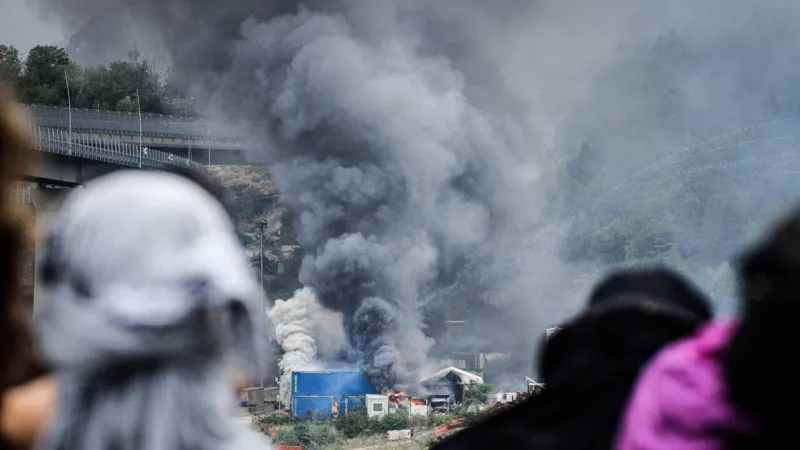
Violent clashes erupted in Val di Susa, Italy, where No Tav activists confronted law enforcement during widespread protests against the Turin-Lyon high-speed rail project, resulting in over one hundred police officers sustaining injuries and 450 individuals being identified by authorities. The unrest marks a significant escalation in the long-running dispute over the controversial infrastructure development.
Police sources confirmed that the injured officers required medical attention, with some sustaining more serious wounds from projectiles and direct confrontations. The sheer number of identified individuals suggests a substantial turnout for the demonstrations, which targeted various construction sites across the valley.
Activists involved in the protests heralded the events as "a great day of struggle for Val di Susa." They asserted that "all construction sites in the valley have been reached and contested," signaling a concerted effort to disrupt operations related to the high-speed rail link. Their declaration underscores a deep-seated commitment to their cause, despite the evident risks of direct confrontation.
The protests represent the latest flashpoint in decades of local opposition to the TAV (Treno Alta Velocità) project, a planned 57.5-kilometer railway tunnel through the Alps connecting Turin, Italy, with Lyon, France. Opponents argue the project is an ecological disaster, a financial boondoggle, and unnecessary given existing rail infrastructure.
Environmental groups and local residents have consistently voiced concerns about the impact of the construction on the delicate alpine ecosystem, including potential harm to water sources and biodiversity. These environmental considerations form a core tenet of the No Tav movement's argument.
Economically, critics contend that the project's astronomical costs far outweigh its potential benefits, diverting crucial public funds from other pressing needs. They challenge the projected economic returns and question the validity of the underlying demand for increased high-speed freight and passenger capacity.
Historically, the Val di Susa has been a crucible for anti-TAV sentiment, witnessing numerous large-scale demonstrations and occasionally violent confrontations. Past incidents include direct action where activists attempted to block construction access and engage with security forces. A previous incident, the Violent Chiomonte Assault, saw Carabinieri vans ignited amid high tensions, indicating the volatile nature of these protests.
Despite the persistent opposition, successive Italian governments have reaffirmed their commitment to the Turin-Lyon project, viewing it as a vital component of European connectivity and economic integration. Rome maintains that the railway will facilitate trade, reduce road congestion, and foster regional development.
The recent escalation places renewed pressure on authorities to manage the volatile situation while upholding public order. The identification of 450 individuals suggests that law enforcement intends to pursue legal action against those involved in the violence, potentially leading to further arrests and judicial proceedings.
Local communities in Val di Susa remain deeply divided over the project. While many staunchly oppose it, a segment of the population supports the development, citing potential job creation and economic opportunities. This division often creates tension within towns and villages directly impacted by the construction.
The No Tav movement continues to garner international attention, drawing solidarity from other anti-globalization and environmental activism groups across Europe. Its resilience serves as a potent example of sustained local resistance against major infrastructure projects.
As investigations proceed, both activists and authorities face critical decisions regarding future actions. The government must balance its commitment to infrastructure development with the imperative to ensure public safety and address legitimate citizen concerns, even amidst such intense clashes. The Val di Susa remains a focal point in Italy's ongoing debate over progress, protest, and environmental stewardship.
The incident underscores the enduring challenges of large-scale infrastructure projects, particularly when confronted by organized and passionate local opposition. The balance between national interest and local autonomy continues to be a contentious issue in Italian politics and public discourse.