 Angel Doris
VAL DI SUSA, Italy – Prime Minister Giorgia Meloni unequivocally condemned the recent acts of violence perpetrated by No Tav protestors in the Val di Susa region, labeling the incidents as "organized violence" following intense clashes that led to the arrest of four foreign individuals. Her strong remarks on Saturday were immediately met with sharp criticism from Democratic Party leader Elly Schlein, who accused the governing coalition of exploiting the volatile situation for partisan political gain, thereby igniting a renewed and fierce debate surrounding the controversial high-speed rail project.
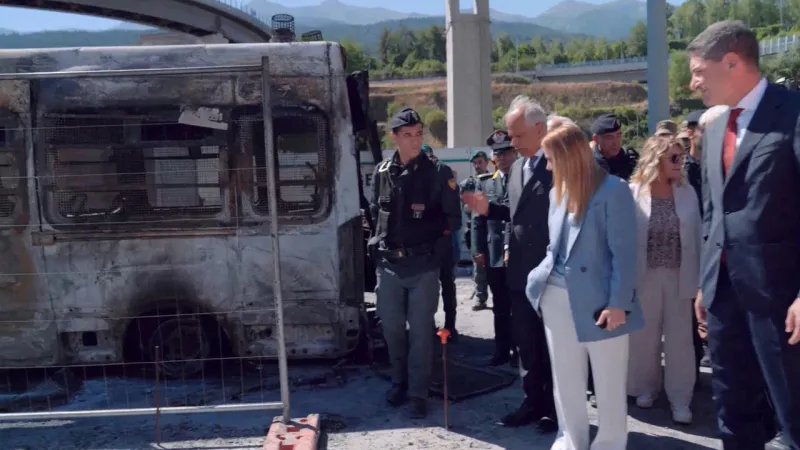
Prime Minister Meloni visited the affected area to assess the situation firsthand and expressed solidarity with law enforcement personnel injured during the skirmishes. Her presence underscored the government's resolve against what it perceives as an escalating threat to public order and infrastructure development. The Prime Minister reiterated her administration's commitment to the Turin-Lyon high-speed rail (TAV) line, asserting that the project is vital for Italy's economic future and connectivity.
The violence erupted on Saturday when groups of anti-TAV activists engaged in confrontational actions against security forces guarding construction sites for the proposed railway. Reports indicate that protestors utilized various projectiles and tactics designed to breach security perimeters, resulting in injuries to several officers and significant property damage. These incidents represent a continuation of decades-long resistance against the infrastructure project.
Authorities swiftly responded to the unrest, apprehending four individuals suspected of participating in the violent demonstrations. These suspects, identified as foreign nationals, are currently undergoing questioning, with their precise roles in the Saturday altercations being meticulously scrutinized by investigators. The arrests highlight the ongoing challenges faced by Italian law enforcement in managing the persistent and often militant No Tav movement.
Opposition leader Elly Schlein responded to Prime Minister Meloni's statements by framing them as an attempt to divert attention from more pressing national issues. Schlein argued that the government was instrumentalizing the Val di Susa events to consolidate its political narrative, rather than seeking genuine solutions to the underlying social and environmental concerns driving the No Tav protests.
The Democratic Party leader urged for a more nuanced approach, advocating for dialogue and a deeper understanding of the local communities' grievances. She emphasized the importance of safeguarding democratic protest while unequivocally condemning violence from any quarter. Schlein's position reflects a broader segment of the political spectrum that seeks to balance development with community engagement and environmental protection.
The No Tav movement, an acronym for No TAV (No to the High-Speed Railway), has been a formidable force in Italy for over three decades, protesting the construction of the Turin-Lyon high-speed rail link. Activists argue that the project is environmentally destructive, economically unsound, and an unnecessary imposition on the Val di Susa valley, which they contend will suffer irreparable damage.
Protestors have long raised concerns about the health impacts of tunneling through asbestos-laden rock, the vast public expenditure involved, and the perceived lack of transparency in decision-making processes. The movement comprises a diverse coalition of local residents, environmentalists, and anarchist groups, united by their opposition to the infrastructure development.
The government, conversely, maintains that the TAV project is a strategic investment that will enhance Italy's position within the European transport network, foster economic growth, and reduce carbon emissions by shifting freight from road to rail. Proponents highlight the benefits of faster transit times for both passengers and goods, connecting Italy more efficiently with France and the rest of Europe.
Historically, the Val di Susa has been a flashpoint for intense confrontations between activists and authorities. Previous administrations, both left and right-leaning, have struggled to quell the protests, which often combine peaceful demonstrations with periods of more aggressive direct action, making it one of Italy's most enduring and contentious socio-political struggles.
The latest round of violence and the subsequent political rhetoric underscore the deep polarization that persists around the TAV project. Prime Minister Meloni's firm stance suggests a low tolerance for disruption, aligning with her party's law-and-order platform. Her government appears determined to push forward with the project despite the entrenched opposition.
Conversely, Schlein's criticism highlights the ongoing political fault lines within Italy, where debates over infrastructure, environmentalism, and social justice frequently become intertwined with broader ideological battles. The accusations of political exploitation are designed to cast doubt on the government's motives and shift public perception.
As investigations into the arrested foreign nationals continue, the incident also raises questions about the international dimension of the No Tav movement and the participation of non-Italian activists in the protests. Authorities are examining whether these individuals are part of broader transnational anarchist or anti-globalization networks.
The events in Val di Susa serve as a potent reminder of the complex interplay between national development goals, local community resistance, and the dynamics of political leadership in contemporary Italy. The region remains a crucial battleground where infrastructure ambitions collide with deeply held environmental and social convictions.
The government faces the delicate task of ensuring public safety and upholding the rule of law while navigating the deeply rooted opposition. The outcome of the current investigations and the political responses that follow will undoubtedly shape the trajectory of both the TAV project and the broader political landscape in Italy.
This recurring cycle of protest, confrontation, and political debate suggests that the resolution to the Val di Susa dispute remains elusive, with neither side showing significant willingness to yield on core principles. The valley continues to symbolize a larger national struggle over development models and civic participation.