Gabriella
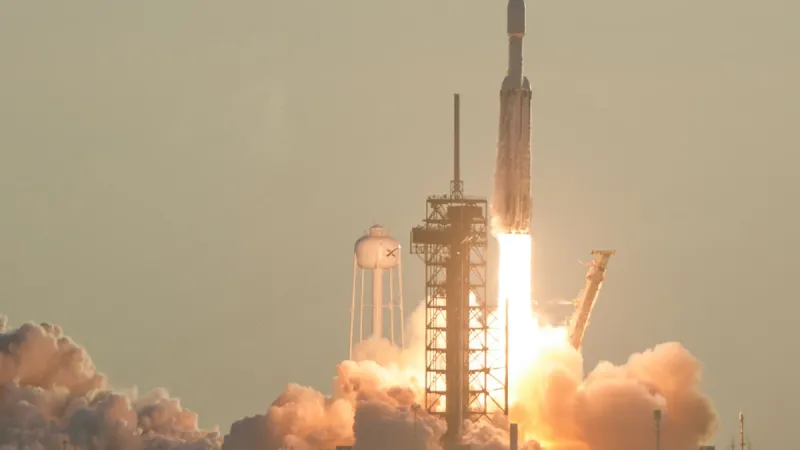
Cape Canaveral, Florida – NASA has successfully launched the cutting-edge Nancy Grace Roman Space Telescope, an ambitious observatory poised to revolutionize humanitys understanding of the universe. This monumental mission, initiated recently from the historic launchpad, aims to explore profound cosmic mysteries, including the nature of dark energy and the discovery of distant exoplanets. Mission officials have declared, "This mission is intended to bring light into the unknown," encapsulating its profound scientific aspirations.
The Nancy Grace Roman Space Telescope, named after NASAs first chief astronomer, is heralded as the next generation of space observatories. It builds upon the legacies of the Hubble Space Telescope and the James Webb Space Telescope, offering a unique wide-field view of the cosmos that will complement their detailed, narrow-field observations. Its deployment marks a significant leap in space-based astronomy.
Former German astronaut Ulrich Walter emphasized the telescope's transformative potential. Walter articulated the space agency's profound goals, noting that the Nancy Grace Roman Space Telescope will provide unprecedented data to tackle some of astrophysics's most enduring questions. Its primary objective involves mapping vast stretches of the universe with unparalleled precision.
A central focus of the mission is unraveling the enigma of dark energy, the mysterious force accelerating the universe's expansion. Scientists currently understand little about this pervasive energy that constitutes approximately 68 percent of the universe's total energy density. The Nancy Grace Roman Space Telescope will create expansive surveys of galaxies and galaxy clusters, allowing researchers to measure the universe's expansion history with greater accuracy than ever before.
Furthermore, the telescope is designed to embark on a comprehensive hunt for exoplanets, planets orbiting stars beyond our solar system. Utilizing the gravitational microlensing technique, it will scan millions of stars in the Milky Way, searching for the subtle dimming caused by an intervening planet. This method is particularly effective for detecting planets far from their host stars, potentially uncovering thousands of new worlds.
The telescope boasts a primary mirror with the same diameter as Hubble's, yet its Wide Field Instrument (WFI) provides a field of view 100 times larger. This capability enables it to capture vast swathes of the sky in a single observation, drastically accelerating the pace of cosmic discovery. Such broad coverage is crucial for statistical studies of dark energy and for discovering rare astronomical events.
Beyond its wide-field capabilities, the Nancy Grace Roman Space Telescope also carries a Coronagraph Instrument (CGI), a technological marvel designed to directly image exoplanets by blocking the glare of their parent stars. While initially a technology demonstration, the CGI holds the promise of capturing the first direct images and spectral data of Earth-like exoplanets, offering clues about their atmospheric compositions.
The mission is expected to operate for at least five years, with a potential extension to ten years, providing a rich trove of data that will occupy astronomers for decades. Its vast data sets will be publicly available, fostering global collaboration and enabling researchers worldwide to contribute to its scientific legacy. This commitment to open science ensures broad engagement.
The development of the Nancy Grace Roman Space Telescope represents a colossal international effort, involving numerous scientific institutions and engineering teams across various countries. This collaborative spirit underscores the universal human desire to explore and comprehend our place in the cosmos, pushing the boundaries of technological innovation and scientific inquiry.
For former astronaut Ulrich Walter, the telescope's launch signifies a new era. He anticipates that the data gathered by the Nancy Grace Roman Space Telescope will not only refine existing cosmological models but also inspire new theories about the fundamental forces shaping the universe. He added that such missions fundamentally alter our perception of reality.
The findings from this groundbreaking observatory are expected to profoundly impact public understanding of astronomy and space exploration, igniting curiosity among future generations of scientists and engineers. As the Nancy Grace Roman Space Telescope begins its solitary journey through the void, it carries with it the hopes of scientists worldwide to illuminate the universe's darkest corners.
Ultimately, the Nancy Grace Roman Space Telescope stands as a testament to human ingenuity and our insatiable quest for knowledge. Its journey promises not just data, but a deeper narrative of our cosmic origins and the potential for life beyond Earth, enriching humanity's understanding of its place within the vast expanse.