 Angela Stefani
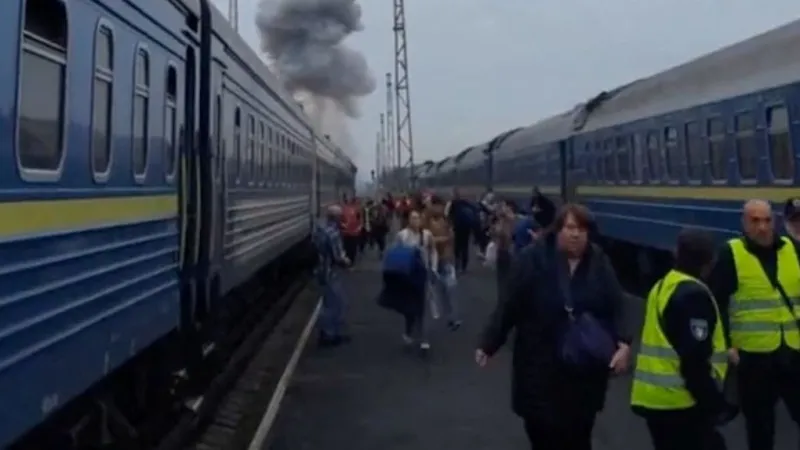
Russia launched an attack on a passenger train near the Polish border, an act a leading military expert has promptly interpreted as a direct and grave threat to Western political leaders. The strike, occurring recently, signals a calculated escalation by Moscow, according to analyst Markus Reisner, who highlighted critical statements emanating from the Kremlin.
Military expert Markus Reisner specifically characterized the passenger train attack as Russia taking the next rung on the escalation ladder. This deliberate targeting, so near a NATO member's frontier, serves as a stark warning to those Western nations actively supporting Ukraine.
The exact location of the strike, while not specified beyond its proximity to the Polish border, amplifies the geopolitical significance. Poland, a steadfast ally and logistical hub for Western aid to Ukraine, lies just kilometers away, making the incident a particularly provocative maneuver.
Reisner, a respected voice in military strategy, drew specific attention to recent pronouncements from the Kremlin. These statements, he asserted, underpin Russia's intent to project power and warn against further Western involvement in the regional conflict.
This incident follows a period of heightened tensions where the boundaries of engagement between Russia and the West have been continually tested. The decision to target a civilian transport infrastructure, even if a military target were present nearby, carries undeniable symbolic weight.
The timing of such an attack is rarely coincidental. Analysts suggest it could be a direct response to recent deliveries of advanced Western weaponry to Ukraine or a pre-emptive warning against potential future strategic decisions by NATO allies.
In Berlin, lawmakers and defense strategists are closely scrutinizing the implications. The incident resonates with earlier warnings from figures like Friedrich Merz, who previously cautioned that Russian Train Attacks Spur Western Alarm and risk European peace.
The Kremlin has consistently accused Western nations of prolonging the conflict through military aid, viewing such support as direct involvement. This train attack can be seen as an extension of that rhetoric into kinetic action.
The nature of the target – a passenger train – is particularly chilling. While no immediate casualty figures or full damage assessments were available, the choice implies a disregard for civilian safety and a message aimed at broader psychological impact.
International condemnation is anticipated, with many nations likely to view this as a blatant disregard for international norms and humanitarian principles. The attack underscores the urgent need for diplomatic solutions, even as military pressures intensify.
President Donald Trump's administration, navigating complex geopolitical landscapes, will likely face renewed calls to re-evaluate its stance on the conflict and potentially bolster defensive capabilities along NATO's eastern flank.
The incident demands a unified Western response that balances deterrence with de-escalation. Allowing such acts to pass without clear consequences could inadvertently invite further, more dangerous provocations from Moscow.
Experts like Reisner believe that the “escalation ladder” concept implies a series of measured steps, each designed to test resolve and communicate intent without immediately triggering a full-scale confrontation. This attack appears to be one such step.
The strategic importance of rail lines in Ukraine, both for civilian transport and military logistics, makes them frequent targets. However, the proximity to a NATO border significantly raises the stakes.
Observers will be watching for official statements from Kyiv and Moscow, seeking further clarification on the target, method, and perceived intent behind the strike.
This development serves as a critical reminder of the volatile nature of the conflict and the constant threat of spillover into neighboring regions, a concern that has driven much of the West's cautious approach.