 Chandra Wijayanto
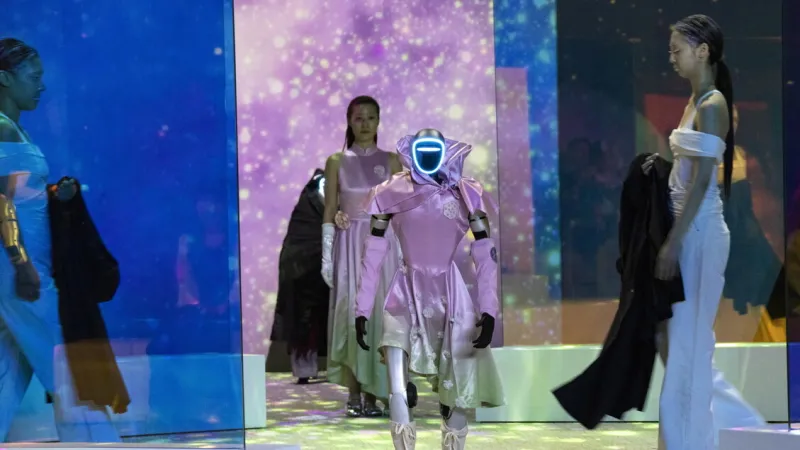
Seoul, South Korea, recently hosted a groundbreaking event where humanoid robots walked the runway alongside human models in the innovative Physical AI Fashion Show. This collaborative spectacle aimed to redefine the boundaries of haute couture by integrating cutting-edge robotics and artificial intelligence into the traditional fashion presentation, offering a profound glimpse into the industrys future.
The pioneering event, held at a prominent exhibition hall in the bustling capital, saw advanced robotic models, meticulously designed to mimic human gait and posture, present avant-garde collections. Organizers stated the show transcended a mere display of garments, serving as an exploration of human-machine synergy in creative domains.
Industry experts and fashion critics attended, observing how the humanoid robots interacted with intricate designs, showcasing fabrics and silhouettes with a precision previously unattainable without human intervention. The robots movements were programmed to complement the garments, highlighting details in ways that emphasized the unique blend of technology and artistry.
One key objective of the Physical AI Fashion Show was to challenge conventional notions of beauty and presentation within the fashion world. By employing both human and robotic figures, the event prompted questions about the role of the model, the essence of performance, and the evolving definition of aesthetic appeal in an increasingly technologically advanced society.
Dr. Lee Min-jun, a leading expert in robotics and AI from the Korean Advanced Institute of Science and Technology, commented on the technical achievements. "These humanoid robots represent a leap forward in dexterous manipulation and lifelike motion," Dr. Lee stated. "The ability to accurately display complex garment drapes and textures opens new avenues for design visualization and production."
The designers involved in the show spoke about the unique challenges and opportunities presented by collaborating with non-human entities. They emphasized a learning curve in adapting their creative vision to the capabilities and limitations of the robot models, fostering an innovative design process that incorporated digital simulation and robotic choreography.
While the spectacle was largely lauded for its innovation, it also ignited discussions about the future of human employment in creative industries. Some critics voiced concerns regarding the potential displacement of human models, stylists, and even designers as AI and robotics become more sophisticated and integrated into the workflow.
However, proponents argue that such technologies will not replace human creativity but rather augment it, providing tools that allow designers to push artistic boundaries further. They view the humanoid robot models as sophisticated canvases, enabling designers to experiment with concepts that might be difficult or impractical with human subjects alone.
This landmark Physical AI Fashion Show is part of a broader global trend seeing artificial intelligence permeate various sectors, from healthcare to finance and now, prominently, the arts and fashion. The integration signals a pivotal moment for how industries perceive and leverage advanced technological capabilities.
The event in Seoul underscores South Koreas burgeoning reputation as a global hub for technological innovation and its willingness to host avant-garde demonstrations that merge scientific advancement with cultural expression. The successful execution of such an ambitious project firmly places the nation at the forefront of the AI-driven future.
Looking ahead, organizers hinted at future iterations of the Physical AI Fashion Show, potentially incorporating more interactive elements or even allowing AI to contribute to the design process itself. The initial success serves as a powerful proof of concept for the symbiotic relationship between humanity and advanced robotics.
As the fashion world grapples with sustainability and digital transformation, the emergence of humanoid robot models could offer novel solutions. For instance, virtual fashion shows featuring photorealistic AI models are already gaining traction, reducing the environmental footprint associated with traditional events. This physical display takes that concept to a new, tangible dimension.
The elegance with which the humanoid robots navigated the runway, exhibiting garments ranging from flowing evening wear to structured architectural pieces, captivated the audience. Their synchronized movements with human counterparts created a compelling visual narrative that challenged perceptions of organic versus synthetic grace.
This pioneering integration exemplifies a paradigm shift where technology is not merely a tool but an active participant in the creative process. The Seoul event has undeniably set a new benchmark for how future fashion presentations might evolve, blurring the lines between art, engineering, and digital spectacle.
The success of this collaborative fashion show also highlights the critical importance of interdisciplinary research and development. The creation of such sophisticated humanoid robots requires expertise spanning mechanical engineering, AI programming, material science, and even aesthetic design, showcasing a truly holistic innovation approach.
While the novelty factor was undeniable, the underlying message was clear: artificial intelligence and robotics are no longer confined to industrial settings or science fiction. They are increasingly becoming integral to cultural and artistic expression, offering new mediums and possibilities for human creativity to flourish.
The fashion industry, historically driven by innovation and spectacle, appears poised to embrace these technological advancements wholeheartedly. The Physical AI Fashion Show in Seoul acts as a powerful harbinger of an era where runways might frequently feature a diverse array of sentient and non-sentient participants, each contributing uniquely to the narrative of style.
Beyond the glitz and glamour, the event fostered critical dialogue among stakeholders about the ethical frameworks necessary to guide the deployment of advanced AI and robotics in fields traditionally dominated by human ingenuity. Striking a balance between progress and preserving human values remains a paramount consideration.
As the echoes of this groundbreaking event reverberate globally, the fashion world anticipates what further innovations humanoid robot technology might bring. From personalized fitting experiences to AI-driven trend forecasting, the integration promises a transformative future for how clothing is conceived, created, and showcased.
The Physical AI Fashion Show in Seoul unequivocally marked a significant milestone, proving that the synergy of human ingenuity and artificial intelligence can unlock unprecedented levels of creativity and redefine the very essence of what a fashion show can be.