 Stefani Rindus
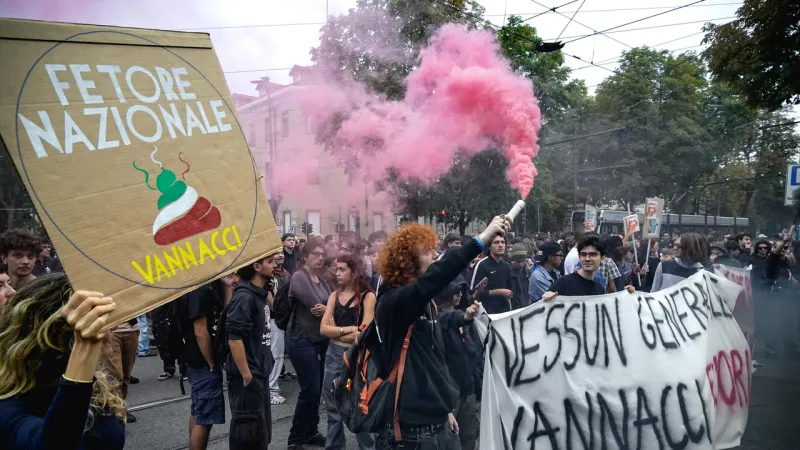
TURIN – A heated demonstration against General Roberto Vannacci erupted recently in the northern Italian city, escalating into tense confrontations between protesters and law enforcement officials. General Vannacci, whose controversial remarks have ignited national debate, promptly characterized his opponents as Antidemocratici, while the Interior Ministry affirmed its stance that no measures are currently planned to dissolve the far-right Forza Nuova (FnV) organization.
The protest, organized by various anti-fascist and progressive groups, saw hundreds converge on the streets of Turin. Participants voiced their strong disapproval of General Vannacci's public statements and perceived affiliations, particularly those outlined in his best-selling, polarizing book.
Eyewitness accounts described moments of high tension, with police officers forming cordons to manage the crowd. While initial reports indicated no major injuries, the atmosphere remained volatile for several hours, underscoring the deep divisions within Italian society regarding the general's rise to prominence.
Responding to the protests, General Vannacci issued a swift rebuke, labeling those demonstrating against him as Antidemocratici. This declaration further fueled the controversy surrounding the military figure, who has become a focal point for conservative and nationalist movements across Italy.
Crucially, the Ministry of the Interior (Viminale) clarified its position regarding calls for the dissolution of Forza Nuova. A spokesperson for the Ministry confirmed, "Nessuna misura per sciogliere FnV," indicating that despite the widespread criticism and public pressure, the government does not intend to take action to ban the far-right political group at this time.
Forza Nuova, a party that identifies with neo-fascist ideals, has frequently been a subject of scrutiny and debate in Italy. Its activities and public demonstrations often draw counter-protests, reflecting the enduring legacy of Italy's fascist past and the ongoing struggle for its contemporary interpretation.
General Vannacci gained national notoriety following the publication of his book, which contained controversial opinions on topics ranging from LGBTQ+ rights to immigration and historical revisionism. His outspoken views led to his removal from a high-ranking military position, though he has since capitalized on the public attention.
The protests in Turin represent a broader pattern of public discontent and ideological clashes observed across Italy in recent months. The political climate remains charged, with various factions vying for influence and legitimacy in the national discourse.
This incident reignites the perennial debate in democratic societies concerning the boundaries of free speech versus speech that is perceived as hateful or divisive. Opponents argue that Vannacci's rhetoric crosses a line, while supporters defend his right to express his opinions.
The Turin event echoes sentiments seen in other Italian cities where similar Anti-Vannacci Protesters Confront Police. These recurring demonstrations highlight a persistent societal fault line that continues to generate headlines and public discourse.
As the political landscape evolves, the controversy surrounding General Vannacci and groups like Forza Nuova is expected to remain a significant topic. Observers anticipate continued vigilance from both civil society organizations and state authorities regarding the expression of extremist ideologies.
The Interior Ministry's decision not to pursue the dissolution of FnV underscores the delicate balancing act faced by the government. They must navigate constitutional guarantees of freedom of association while addressing public concerns about groups perceived as a threat to democratic values.
Public opinion remains sharply divided on General Vannacci. While some view him as a necessary voice against perceived societal decline, others see his views as regressive and harmful, threatening the fabric of an inclusive society.
Media outlets across Italy continue to extensively cover the general's statements and the public reaction, further amplifying the debate and ensuring his controversial positions remain at the forefront of national conversations.
The Turin protest against General Vannacci serves as a potent reminder of Italy's complex political landscape, where historical legacies and contemporary ideological battles frequently intersect, often resulting in public confrontations and governmental deliberations.