 Robert Andrison
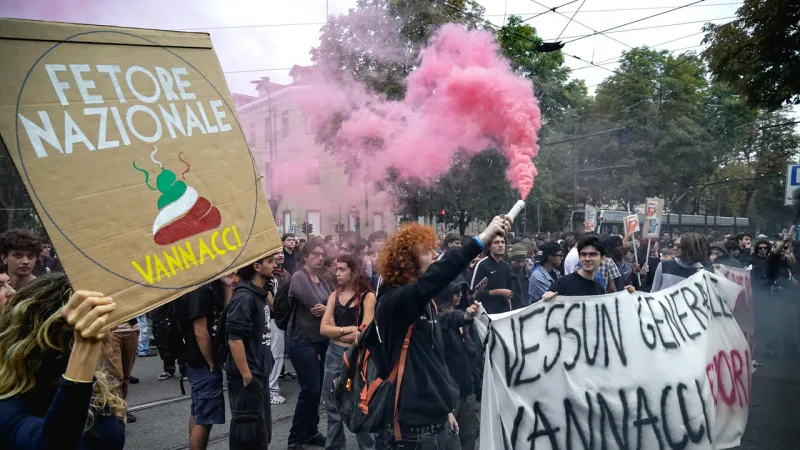
ITALY – Recent anti-Vannacci demonstrations escalated into street confrontations, culminating in protesters from social centers hurling eggs at law enforcement personnel. The volatile scene unfolded as activists voiced their opposition to General Roberto Vannacci, before the groups subsequently formed a march through city streets.
The incident marks a palpable rise in public tension surrounding the contentious figure of General Vannacci. Known for his outspoken conservative views and a self-published book, he has become a lightning rod for both support and condemnation across the Italian political spectrum.
Initial reports indicated that the gathering, organized by various social centers, began as a peaceful picket line. However, the atmosphere quickly deteriorated upon the arrival of police contingents tasked with maintaining public order and managing potential disruptions.
Eyewitness accounts describe a sudden surge in agitation among segments of the crowd. The projectiles, primarily eggs, were reportedly thrown directly at the police formation, signaling a sharp turn from peaceful protest to active confrontation.
Law enforcement officers responded by reinforcing their lines and implementing crowd control protocols, though specific details regarding arrests or injuries remain undisclosed in immediate aftermath reports. The primary objective appeared to be containment and de-escalation of the volatile situation.
Following the brief but intense skirmish, a significant portion of the demonstrators coalesced into an organized procession. This move transformed the static protest into a dynamic march, navigating through urban thoroughfares and continuing to vocalize their dissent.
The participation of social centers in the anti-Vannacci protest is noteworthy. These autonomous, often self-managed cultural and political spaces frequently serve as hubs for left-wing activism and provide platforms for grassroots opposition to perceived governmental or societal injustices.
This event underscores the deepening ideological divides within Italy, a nation currently governed by a right-wing coalition led by Prime Minister Giorgia Meloni. Public figures like General Vannacci often symbolize specific cultural and political stances that ignite strong reactions from opposing factions.
Such direct confrontations between protesters and police are not uncommon in Italian political life, reflecting a long history of street-level activism. The throwing of projectiles, while a relatively minor act in some contexts, signifies a clear breakdown in the non-violent parameters of demonstration.
The broader discourse surrounding General Vannacci's public statements has prompted national conversations about freedom of expression versus the promotion of divisive rhetoric. This ongoing debate contributes to an environment where public demonstrations frequently become flashpoints for deeper societal disagreements.
Efforts to counter prejudice and foster inclusion, as seen in initiatives like those where Italian schools launch competitions to combat prejudice, stand in stark contrast to the confrontational tactics witnessed during the anti-Vannacci demonstration. These educational programs highlight alternative approaches to addressing societal divisions.
The incident serves as a stark reminder of the challenges authorities face in balancing the right to peaceful assembly with the imperative to maintain public safety. Navigating these complex dynamics requires careful consideration and a robust framework for managing dissent without exacerbating tensions.
As the country moves further into 2026, the political landscape remains charged. Debates about national identity, social values, and the role of traditional institutions continue to shape public discourse and animate various forms of activism.
There has been no immediate official statement from General Vannacci or the Ministry of Interior regarding the specific incident. Such silence is often interpreted as a strategy to avoid further legitimizing the protest or escalating the public exchange.
The trajectory of these social movements, particularly those opposing prominent figures, will likely influence future political narratives. The anti-Vannacci sentiment, while manifesting in direct action, also represents a significant current of thought within a segment of the population.
Police authorities will undoubtedly analyze the events to refine their crowd management strategies for future protests. The focus remains on preventing similar escalations while upholding democratic rights.
This episode reinforces the vibrancy, and at times volatility, of Italian civic engagement. From parliamentary debates to street protests, the nation continues to grapple with its identity and direction amidst evolving political currents.