 Chandra Wijayanto
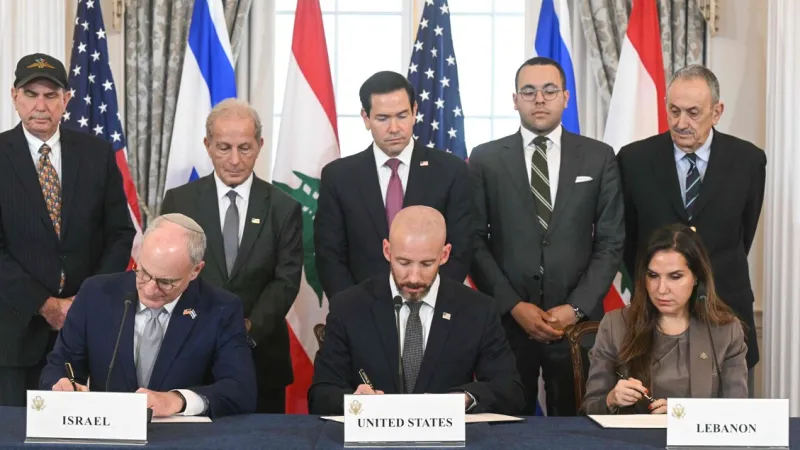
WASHINGTON – Israel and Lebanon today formally inked a landmark U.S.-brokered agreement in the nation's capital, a deal designed to delineate their contentious maritime border and foster stability in the volatile Eastern Mediterranean. Israeli Prime Minister Benjamin Netanyahu hailed the accord as a significant strategic blow to Iran, while Lebanese President Michel Aoun and U.S. Special Envoy Amos Hochstein lauded it as a crucial initial step toward broader regional peace.
The culmination of protracted negotiations, the Israel-Lebanon agreement marks a rare moment of direct diplomatic engagement between two states technically still at war. This pact is expected to unlock hydrocarbon exploration opportunities in the disputed waters, potentially transforming the economic landscapes of both nations.
Prime Minister Netanyahu articulated his conviction that the newly signed accord fundamentally weakens Iran's regional influence. "This agreement," Netanyahu stated, "is a direct blow to the Iranian axis, diminishing its ability to sow discord and instability along our northern frontier." He emphasized the strategic implications for Israeli security, framing the deal as a preventative measure against future provocations.
In Beirut, Lebanese President Michel Aoun characterized the agreement as a vital first step, underscoring its potential to safeguard Lebanon's sovereign rights over its natural resources. His pragmatic stance reflects a broader national imperative to leverage economic opportunities despite the deep-seated political divisions within the country.
Conversely, the powerful Iran-backed Hezbollah movement swiftly condemned the agreement, asserting it would "cause internal divisions" and serve Israeli interests. A Hezbollah spokesperson reiterated the group's opposition, highlighting its belief that the pact does not adequately address Lebanon's long-term strategic concerns and could be exploited by adversaries. This dissenting view complicates the internal consensus needed for lasting implementation.
President Donald Trump's administration played a pivotal role in mediating the complex negotiations, with multiple rounds of shuttle diplomacy preceding the final signing. President Trump lauded the agreement as a testament to persistent U.S. diplomatic efforts to promote stability in the Middle East, a region often fraught with intractable conflicts. This achievement echoes similar sentiments previously reported, such as when US Brokers Israel-Lebanon Peace Framework, Netanyahu Hails Iran Setback.
The President also drew a direct link between this diplomatic breakthrough and broader regional security challenges, specifically referencing Iran's actions. President Trump stated that Iran had "violated the ceasefire with attacks on Hormuz," indicating a rise in tension in the strategically critical Strait of Hormuz. This remark underscores Washington's enduring concerns about Iranian behavior and its potential to destabilize international shipping lanes.
Italy, through a statement from Palazzo Chigi, expressed its support for the agreement, declaring, "Italy will do its part" in supporting its implementation and contributing to regional stability. This international endorsement highlights the global recognition of the accord's potential to de-escalate tensions and foster cooperation.
The agreement specifies the demarcation line for the maritime border, an issue that has been a flashpoint for decades. While primarily focused on economic zones and potential energy reserves, the symbolic weight of the deal extends far beyond its technical parameters. It offers a template for future de-escalation in other areas of contention.
Observers note that securing this agreement required delicate balancing acts by all parties involved, navigating domestic political pressures and regional rivalries. The long-term success of the pact will largely depend on sustained political will from both Israeli and Lebanese leadership, alongside continued international oversight.
The immediate relief brought by the Israel-Lebanon agreement stands in stark contrast to the persistent volatility evident elsewhere in the region, particularly around the Strait of Hormuz. The ongoing tensions there, exacerbated by President Trump's accusations against Iran, serve as a potent reminder of the fragility of peace initiatives amidst broader geopolitical struggles.
This diplomatic achievement, meticulously pieced together by U.S. envoys, showcases a strategic attempt to chip away at the long-standing animosities that have defined the Levant. By focusing on shared economic interests, the architects of the deal hope to build a foundation for more expansive dialogue in the future, even as hardliners on both sides remain skeptical.
The maritime border demarcation is particularly crucial for the development of offshore gas fields, such as Israel's Karish field and Lebanon's Qana prospect. Unlocking these resources could provide significant revenue streams, potentially easing economic crises, especially in Lebanon, which has grappled with severe financial hardship.