 Chris Robert
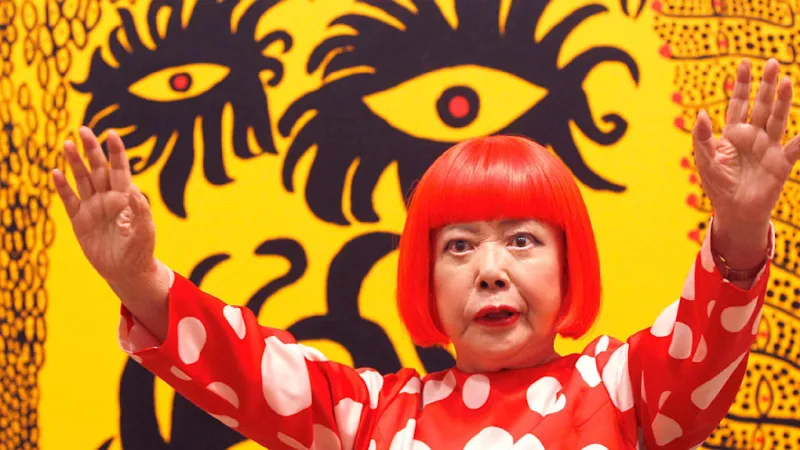
The international art community is mourning the loss of legendary Japanese artist Yayoi Kusama, who passed away recently at the age of 97. Kusama, whose prolific career spanned more than eight decades, was renowned globally for her distinctive use of polka dots, immersive Infinity Mirror Rooms, and captivating sculptural works that offered a unique lens into her lifelong experiences with hallucinations. She created art until her final days, translating her deeply personal visions into universally recognized masterpieces.
Kusama maintained throughout her life that her art was a direct manifestation of how she perceived the world. From an early age, she experienced vivid hallucinations, often seeing her surroundings covered in patterns of dots, nets, and phallic protrusions. These deeply personal and often unsettling visions became the wellspring of her unique artistic vocabulary, transforming what might have been a debilitating condition into a profound creative force.
Her works, instantly recognizable and profoundly impactful, have been exhibited in prestigious galleries and museums across the globe, cementing her status as one of the most significant contemporary artists of the 20th and 21st centuries. Major retrospectives have captivated audiences from New York to Paris, and London to Tokyo, drawing millions and often setting attendance records.
Born in 1929 in Matsumoto, Nagano Prefecture, Kusama endured a challenging childhood marked by family conflict and strict societal norms. She began formally studying nihonga, traditional Japanese painting, in Kyoto, but soon found its constraints stifling. Driven by an urgent need for artistic freedom and recognition, she moved to New York City in the late 1950s.
In New York, Kusama quickly immersed herself in the burgeoning avant-garde scene, associating with artists like Andy Warhol and Donald Judd. Her early large-scale net paintings and soft sculptures garnered critical attention, but it was her performance art and public happenings, often involving nudity and protest against the Vietnam War, that truly established her as a radical figure.
Despite her successes in New York, Kusama battled severe mental health issues, a struggle she openly addressed and which profoundly informed her art. In the early 1970s, she returned to Japan, voluntarily admitting herself to a psychiatric hospital where she lived for decades. This period, far from hindering her output, provided a stable environment for her continued prolific creation.
Her signature motifs, particularly the polka dot, evolved over her career from a representation of self-obliteration and infinity to a more celebratory symbol of life and the universe. Kusama described her use of dots as a way to self-obliterate and become one with the universe, dissolving into the infinite patterns.
Kusama leaves behind an unparalleled legacy of courage, innovation, and artistic integrity. Her work challenged conventional boundaries of art, gender, and mental health, inspiring countless artists and admirers worldwide. She transcended labels, moving effortlessly between painting, sculpture, installation, film, fashion, and poetry.
In her later years, Kusama achieved immense commercial success, with her works commanding high prices at auction and her exhibitions becoming global phenomena. Her brightly colored, immersive environments resonated deeply with contemporary audiences, especially through social media, cementing her status as a pop culture icon while maintaining critical acclaim.
Kusama believed art could heal and connect people. Her relentless pursuit of creativity, even in the face of personal demons, serves as a powerful testament to the human spirit's capacity for transformation and expression. She famously stated that she painted until the very end, viewing art not merely as a profession but as her very existence.
The passing of Yayoi Kusama marks the end of an era for contemporary art. Yet, her vibrant, boundary-pushing vision and her iconic dots will undoubtedly continue to inspire and provoke, inviting viewers to explore the infinite possibilities of both art and the human mind for generations to come. Her unique ability to share her internal world, fraught with personal struggles, in a way that resonated universally, ensures her enduring place in art history.