Gabriella
Ukraine faced a barrage of Russian missile strikes today, resulting in at least 11 civilian fatalities, prompting Ukrainian President Volodymyr Zelensky to denounce the attacks as a "gift" marking Russian President Vladimir Putins birthday. The deadly assaults targeted multiple cities, including Pryluky, Dnipro, and Kremenchuk, escalating the conflict's human toll.
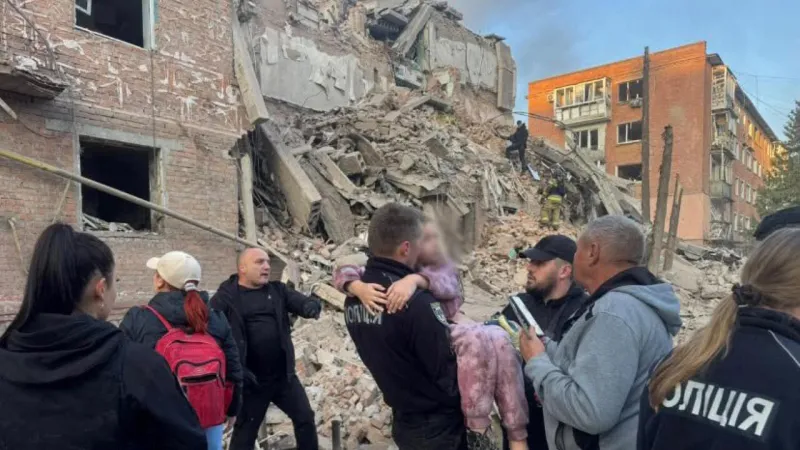
In Pryluky, a city in the Chernihiv Oblast, emergency services responded to significant devastation. Rescue teams worked tirelessly amidst the rubble, where numerous individuals were trapped following the bombardment.
Among those rescued in Pryluky were three children, a stark reminder of the indiscriminate nature of the recent attacks and their profound impact on Ukraine's youngest population. Their conditions were not immediately detailed, but their survival underscored the urgent humanitarian crisis.
Concurrently, missile strikes also impacted the strategic cities of Dnipro and Kremenchuk, both located in central Ukraine. While specific casualty figures for these areas were not immediately available, initial reports indicated widespread damage and civilian distress.
President Zelensky delivered his scathing indictment via a public address, stating, "Today alone 11 dead in Ukraine, the Russians' birthday gift for Putin." This powerful condemnation sought to draw a direct line between the military actions and the perceived celebratory timing for the Russian leader.
The Ukrainian leader's remarks underscore the deep animosity and the perception in Kyiv that Moscow's aggression often carries symbolic weight, aimed at psychological warfare alongside physical destruction. Such pointed pronouncements have become a recurring feature as the conflict endures.
These latest attacks represent a continuation of Russia's full-scale invasion of Ukraine, which commenced in February 2022. Despite international condemnation and sanctions, missile and drone assaults on Ukrainian cities remain a frequent occurrence, targeting both military and civilian infrastructure without distinction.
International bodies and allied nations have consistently called for an end to hostilities and have denounced attacks on civilian populations as war crimes. However, such appeals have largely failed to deter the ongoing aggression or prevent further loss of life.
The relentless bombardment has exacted a tremendous humanitarian cost, displacing millions of people and causing widespread destruction of homes, schools, and hospitals across Ukraine. Rescue operations, like those mounted in Pryluky, have become a grim routine for the nation's dedicated first responders.
Despite the persistent threats and the daily dangers, Ukrainian citizens and emergency services continue to demonstrate remarkable resilience. Volunteer groups and municipal workers often provide immediate aid and support in the aftermath of strikes, embodying a steadfast spirit of defiance against the sustained assault.
As the conflict enters another year in 2026, the latest strikes serve as a stark reminder of the daily perils faced by Ukrainians and the volatile geopolitical landscape. President Zelensky's emotionally charged comments highlight the profound human and political stakes involved in every new casualty reported, echoing the ongoing tragedy unfolding across the nation.