 Demian Sahputra
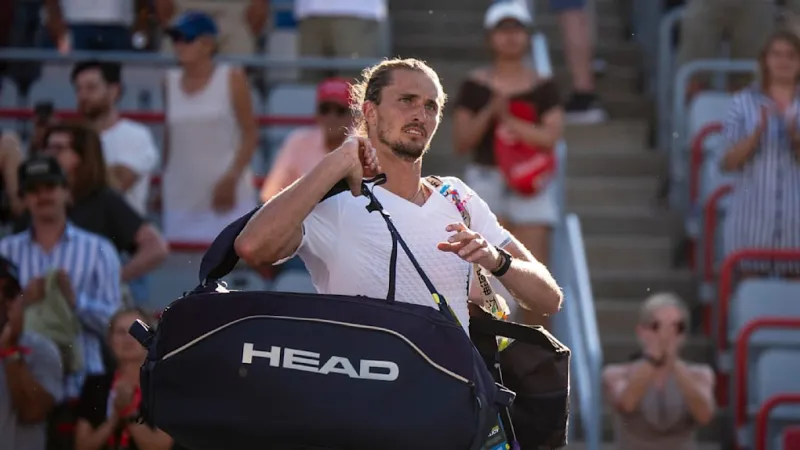
Montreal – Top-seeded German tennis star Alexander Zverev experienced an unexpected early exit from the Canadian Open Masters tournament, suffering a decisive defeat to the Netherlands Tallon Griekspoor. The loss, which unfolded in three sets with a scoreline of 7:6 (7:3), 2:6, 4:6, significantly jeopardizes Zverevs intended warm-up strategy for the upcoming US Open.
The highly anticipated contest saw Zverev secure the initial set in a tie-break, hinting at a potentially dominant performance from the tournaments number one seed. However, the momentum swiftly shifted, with Griekspoor finding his rhythm and exploiting Zverevs inconsistencies in the subsequent two sets.
Griekspoor, demonstrating remarkable composure and strategic play, capitalized on his opportunities, breaking Zverevs serve at critical junctures. His aggressive baseline game and precision served proved too much for the German, who appeared visibly frustrated as the match progressed.
This tournament in Montreal was specifically earmarked by Zverev as a crucial hard test, a vital staging ground to fine-tune his game and build confidence ahead of Flushing Meadows. An early departure at such a pivotal preparatory event undoubtedly creates unforeseen challenges for the German contingent.
Masters 1000 events, like the Canadian Open, are universally regarded as essential proving grounds for elite players, offering high-level competition against formidable opponents. They provide invaluable match practice under Grand Slam-like pressure, making Zverevs premature departure a notable setback.
The defeat marks a significant moment for Griekspoor, who achieved one of his career-best victories against a top-ranked player. His performance in Montreal suggests a growing threat on the ATP Tour, particularly on hard courts.
For Zverev, the loss necessitates a critical re-evaluation of his training regimen and tactical approach in the finite window remaining before the seasons final Grand Slam. The psychological impact of such a defeat, particularly when seeded first, can be considerable.
Analysts had widely predicted a strong showing from Zverev in Montreal, anticipating a deep run that would solidify his status as a contender for the US Open title. This outcome, however, introduces an element of uncertainty into those predictions.
The road to a Grand Slam title is fraught with challenges, and unexpected losses in warm-up tournaments, while not uncommon, can disrupt a players rhythm and confidence. Zverev now faces the task of regrouping and refocusing his efforts without the desired competitive match play.
The competitive landscape of professional tennis continually highlights the fact that no victory is guaranteed, regardless of seeding or reputation. Underdogs frequently upset the established order, providing compelling narratives and keeping the sport dynamic.
Zverevs performance in the coming weeks will be under intense scrutiny as he endeavors to regain his top form. The pressure to deliver at the US Open, a tournament where he has previously reached the final, will only intensify following this Canadian Open stumble.
His team will undoubtedly work diligently to analyze the match, address any technical or mental shortcomings, and ensure he arrives in New York prepared for the rigorous demands of a two-week Grand Slam. The path to Grand Slam glory is rarely linear, and Zverev now faces a steeper climb.
This early exit does more than just cut short his Montreal campaign; it transforms his pre-US Open narrative from one of confident preparation to one of urgent recalibration. The tennis world will keenly observe how the top German athlete responds to this unexpected challenge.