 Chris Robert
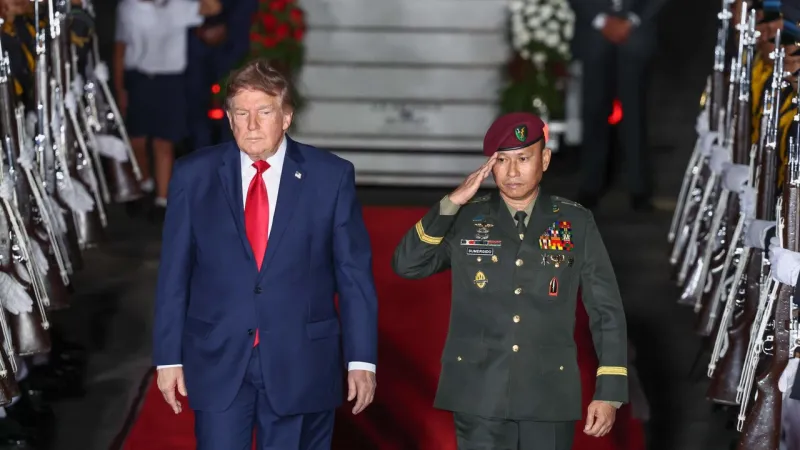
MANILA – President Donald Trump arrived in the Philippines today to convene with the prime ministers of India, Japan, and Australia, initiating a crucial Quadrilateral Security Dialogue summit aimed at strengthening regional cooperation and stability. This high-stakes engagement precedes a significant trilateral meeting scheduled for tomorrow in China, where President Trump will join Presidents Xi Jinping and Vladimir Putin to address a range of pressing global and bilateral issues.
Today's Quad summit in Manila underscores the United States' sustained commitment to its Indo-Pacific strategy, a framework designed to foster a free, open, and prosperous region. Discussions are expected to center on maritime security, economic collaboration, infrastructure development, and responses to humanitarian crises and disaster relief efforts across the Indo-Pacific.
The gathering with Prime Minister Narendra Modi of India, Prime Minister Fumio Kishida of Japan, and Prime Minister Anthony Albanese of Australia serves as a robust signal of solidarity among democratic nations facing shared challenges. These leaders aim to bolster a rules-based international order and promote economic resilience amidst evolving geopolitical landscapes.
The strategic importance of the Quad has grown significantly in recent years as member nations seek to balance regional influences and secure vital trade routes. This summit allows President Trump to reaffirm key alliances and coordinate multilateral responses to emerging threats, ensuring a unified approach to complex issues.
Immediately following the Manila summit, President Trump will pivot to a radically different diplomatic forum in China. The trilateral meeting with President Xi Jinping and President Vladimir Putin is anticipated to cover sensitive topics, including trade imbalances, regional security concerns such as nuclear proliferation, and avenues for de-escalation in various global flashpoints.
This sequence of engagements highlights the intricate nature of American foreign policy in 2026, balancing traditional alliances with direct engagement of strategic rivals. The discussions with China and Russia represent an opportunity to manage competition, prevent miscalculation, and explore areas of potential cooperation despite significant ideological and geopolitical differences.
The presence of both the Chinese and Russian leaders at the upcoming trilateral signals a mutual recognition of the need for high-level dialogue on global governance and stability. Each nation brings its own agenda to the table, making the negotiations complex but vital for international relations.
Observers widely view this diplomatic journey as a critical test of President Trump's ability to navigate a multi-polar world, where the United States seeks to maintain its influence while adapting to new power dynamics. The outcomes from both summits will undoubtedly shape the trajectory of international relations for the foreseeable future.
The United States has been actively strengthening its relationships throughout the region, building on various diplomatic initiatives. Such efforts include forging stronger bonds with allies like South Korea and Japan, a sentiment echoed in recent developments such as the new dawn declared for South Korea-Japan relations, which signify a renewed focus on regional cooperation.
Further underscoring the United States' commitment to economic engagement and strategic partnerships, President Trump has previously highlighted American investment and job creation in key sectors. This strategic outreach builds on prior successes, including the approval of the Alaska LNG Project, which President Trump specifically credited to South Korean investment, demonstrating the tangible benefits of international collaboration.
The impending trilateral meeting also occurs within a broader context of evolving great power relations. Russia's strategic posture, for instance, continues to be a subject of international scrutiny, particularly concerning its alliances and influence, as illustrated by recent reports signaling stronger Russia-North Korea ties.
Ultimately, President Trump's dual diplomatic mission to the Indo-Pacific and China illustrates a bold and pragmatic approach to foreign policy, simultaneously reinforcing alliances and engaging adversaries in direct dialogue. The world watches keenly as these critical discussions unfold.