Gabriella
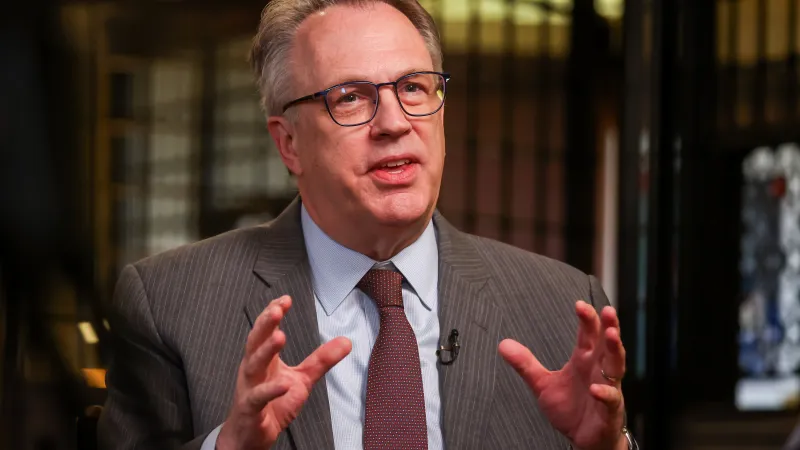
New York Federal Reserve President John Williams has publicly stated that he anticipates no further interest rate hikes by the central bank in 2027, a projection that directly diverges from the current consensus among many financial market traders. This outlook, shared as the nation navigates a complex economic landscape in 2026, hinges on a continued deceleration of inflation pressures.
Williams specified his view includes one more modest rate increase sometime in 2026 before the anticipated pause. This single expected adjustment reflects a careful approach to monetary policy as the Federal Reserve seeks to stabilize prices without unduly hindering economic growth.
The market, in contrast, appears to be pricing in a higher probability of multiple rate hikes extending into 2027, or at least a more prolonged period of elevated rates. This discrepancy highlights differing interpretations of incoming economic data and future inflationary trajectories, sparking debate among analysts.
The central tenet of Williams assessment is the observed easing of inflationary pressures. Indicators such as slowing consumer price index (CPI) growth, moderating wage increases, and stabilizing supply chains contribute to this more optimistic view on price stability.
The Federal Reserve operates under a dual mandate from Congress: to achieve maximum employment and maintain price stability. Williams perspective suggests that the Fed may be closer to achieving its inflation target, allowing for a less restrictive monetary stance in the outer years of the forecast.
As president of the New York Fed, John Williams holds a significant position within the Federal Open Market Committee (FOMC), influencing policy decisions and often serving as a bellwether for the wider committee’s sentiment. His statements carry considerable weight in financial circles.
A pause in the Fed rate hike cycle in 2027 would have profound implications for various sectors of the economy. Businesses could anticipate more stable borrowing costs, potentially encouraging investment and expansion. Consumers might see mortgage rates plateau, offering some relief in the housing market.
Persistent high interest rates typically translate to higher borrowing costs for everything from car loans to corporate bonds. Williams forecast offers a glimmer of hope for some moderation in these costs, assuming the Fed follows a similar path as inflation subsides.
Financial markets react sharply to signals regarding future monetary policy. A clear indication of a rate hike pause could inject greater certainty into the investment climate, influencing asset allocation and capital flows across various industries.
Despite Williams confident projection, all economic forecasts are inherently subject to uncertainty. The Federal Reserve has consistently emphasized its data-dependent approach, meaning any future policy path, including a 2027 pause, remains contingent on evolving economic conditions and incoming economic reports.
While focusing on domestic inflation, the Fed also considers the broader global economic environment. International trade dynamics, geopolitical events, and commodity prices all play a role in shaping the U.S. economic outlook and, consequently, monetary policy decisions.
In 2026, under President Donald Trump administration, economic policy often emphasizes growth and job creation. The Fed s actions, while independent, always operate within this broader political and economic context. A stable interest rate environment could align with the administration’s goals for sustained economic expansion.
The delicate balance between curbing inflation and fostering economic growth remains the central challenge for the Federal Reserve. Prematurely stopping rate hikes could risk re-igniting inflation, while overly aggressive tightening could tip the economy into recession.
The prospect of no further rate increases in 2027, as articulated by Williams, paints a picture of a more normalized interest rate environment than many had previously feared. This potential shift signals confidence in the efficacy of the Fed s current and planned actions to bring inflation under control.
Traders and analysts will scrutinize Williams comments, recalibrating their own models and predictions for future Fed moves. This ongoing dialogue between central bankers and financial markets is a crucial component of modern economic governance, influencing investment strategies worldwide.
The coming months will provide further data to either affirm or challenge Williams perspective. The Federal Reserve, under the leadership of its various presidents, will continue to monitor economic indicators closely, ready to adjust its strategy as circumstances demand, always with an eye toward its mandated objectives of price stability and maximum employment.