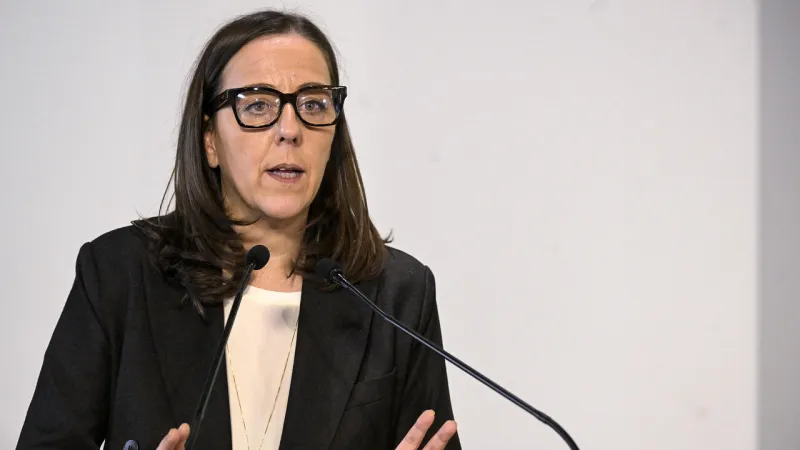
Angela Stefani

Magdeburg, Germany – Ulrich Siegmund, the Alternative for Germany (AfD) top candidate for Saxony-Anhalt, has definitively stated he would not accept election as Minister-President through a simple majority facilitated by an abstention from the Bündnis Sahra Wagenknecht (BSW) party in a potential third ballot. Siegmund emphasized his necessity for a stable parliamentary team to govern effectively over a full five-year legislative term.
His declaration underscores a significant hurdle in the state's political landscape, where fragmented electorates often lead to complex coalition negotiations. Siegmund made his position unequivocally clear, asserting that a purely formal leadership, devoid of a legislative majority, would be untenable and unproductive for the state.
“What good does it do me to be a formal Minister-President without a majority in parliament?” Siegmund questioned, reiterating his commitment to robust governance. “I need a stable team for five years.” This statement highlights a pragmatic approach to political power, prioritizing operational capacity over a titular role.
The German parliamentary system typically requires a candidate for Minister-President to secure an absolute majority in the first two rounds of voting. If unsuccessful, a third round allows for a simple majority. It is in this third scenario that an abstention from a party like BSW could theoretically enable Siegmund's election without their direct support, a scenario he now explicitly rejects.
This firm stance by the AfD leader presents a formidable challenge for any potential government formation in Saxony-Anhalt. It suggests that the party, despite its growing electoral success, is not willing to compromise on fundamental requirements for stable governance, even if it means foregoing a leadership position.
The BSW, a relatively new political entity, often positions itself in opposition to mainstream parties, and its potential abstention in such a vote could be interpreted in various ways – from strategic non-interference to a tacit signal of a lack of confidence in the political establishment.
Observers note that Siegmund's demand for a clear mandate is rooted in the practicalities of governing. A Minister-President without a stable majority faces constant legislative gridlock, making it exceedingly difficult to pass budgets, implement policies, or navigate political crises effectively.
Such a scenario would likely lead to frequent no-confidence votes and potentially snap elections, further destabilizing the state's political environment. Siegmund's comments reflect a desire to avoid such parliamentary paralysis, which could undermine public trust and hinder progress for Saxony-Anhalt residents.
The AfD's strategy, as articulated by Siegmund, appears to be a calculated move to project an image of serious governance, contrasting with perceptions of political opportunism often leveled against the party. They seek to demonstrate that their aspiration for leadership is tied to the capacity to lead effectively.
This development is particularly notable given the AfD's increasing prominence across Germany and the ongoing debates surrounding its role in coalition governments. The party has consistently sought to establish itself as a legitimate governing force, and Siegmund's refusal of a weak mandate aligns with this broader objective. For further context on the AfD's position, readers can delve into AfD Candidate Siegmund Rejects BSW Aid, Demands Absolute Majority.
As Saxony-Anhalt heads toward potential government formation talks, Siegmund's unequivocal statement is likely to reset expectations for all parties involved. It signals that the path to a stable regional government will necessitate genuine cross-party majorities, rather than procedural loopholes, reflecting a deepening political divide and the complexities of modern German politics.