 Chandra Wijayanto
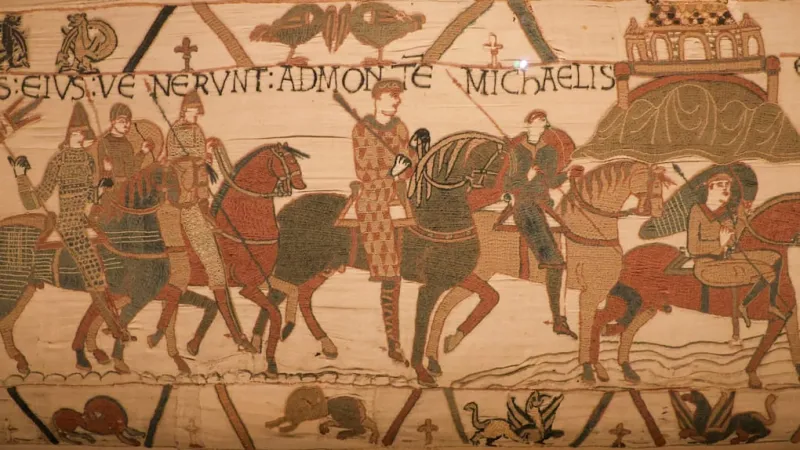
London, England, prepares to host a monumental exhibition as the ancient Bayeux Tapestry, a revered historical artifact, arrives on English soil for the very first time, prompting a re-evaluation of the nation's foundational history. This landmark event unearths a narrative of French-speaking colonialists who profoundly shaped and dominated the land for centuries, challenging conventional understandings of English national identity.
The loan of the nearly 70-meter-long embroidered cloth, which meticulously chronicles the 1066 Norman Conquest, represents a significant cultural exchange between France and the United Kingdom. Its display offers an unprecedented opportunity for the British public to engage directly with a visual record of their country's origins, depicting the brutal yet transformative arrival of William the Conqueror and his forces.
Historians emphasize that the narrative presented by the tapestry goes beyond mere conquest; it illustrates a fundamental shift that can be understood through a colonial lens. The victorious Normans, primarily French speakers from Normandy, established a new ruling class, imposed their language, laws, and administrative systems, effectively subjugating the Anglo-Saxon populace.
This period saw a radical reordering of English society, with Norman French becoming the language of power, governance, and the aristocracy. While English persisted among the common people, its evolution was irrevocably altered, absorbing thousands of French words and grammatical structures that remain evident in modern English today. The conquerors were, in essence, foreign rulers who systematically exploited the resources and labor of their new territory.
Indeed, the figure known to history as William the Conqueror was, in his native tongue, Guillaume le Conquerant. This subtle linguistic distinction underscores a broader historical phenomenon: the often-suppressed fact that England experienced a profound and lengthy period of rule by a foreign, French-speaking elite, a reality that many, including some French historians, have historically downplayed or overlooked.
The arrival of the Bayeux Tapestry sparks conversations about historical memory and national narratives. For centuries, the Norman Conquest has been portrayed primarily as a decisive battle or a turning point rather than a prolonged colonial occupation. The tapestry serves as a tangible, visual reminder of this often-uncomfortable truth, inviting deeper scholarly and public discourse.
Scholars suggest that this historical amnesia, particularly in France, stems from complex geopolitical and cultural factors. The idea of England as France's most successful ex-colony might challenge modern perceptions of national identities, which often emphasize distinct and separate trajectories rather than deeply intertwined, and at times, dominant-subordinate relationships.
The exhibition of the Bayeux Tapestry in England allows for a critical examination of how historical events are framed and remembered. It compels observers to consider the long-term impact of the Norman Conquest, not just on the English monarchy or aristocracy, but on the very fabric of English culture, language, and social structure.
This unique display is expected to draw considerable attention, not only from historians and academics but also from the general public eager to witness a masterpiece of medieval art and reconsider a pivotal chapter in English history. Its presence in England will undeniably foster a deeper, perhaps more nuanced, understanding of the complex relationship between England and France.
The tapestry, ordinarily housed at the Musee de la Tapisserie de Bayeux in Normandy, France, has rarely traveled, making this transfer an extraordinary diplomatic and cultural achievement. Its temporary relocation provides an unparalleled opportunity to bridge historical understanding and cultural appreciation across the Channel.
Experts anticipate the exhibition will stimulate renewed interest in Anglo-Norman studies, prompting fresh research into the social, economic, and political transformations wrought by the Conquest. The threads of the tapestry tell a story of power, conquest, and the enduring legacy of linguistic and cultural imposition.
This move serves as a poignant reminder that national histories are rarely simple narratives of linear development. Instead, they are often characterized by layers of influence, conquest, and the subsequent efforts to assimilate or resist foreign domination. The Bayeux Tapestry stands as a silent, yet powerful, witness to these intricate processes.
Ultimately, the Bayeux Tapestry's journey to England is more than a cultural loan; it is an invitation for a profound historical reckoning. It challenges both nations to confront a shared past that is far more complex and intertwined than popular memory often permits, highlighting England's foundational colonial experience.