 Demian Sahputra
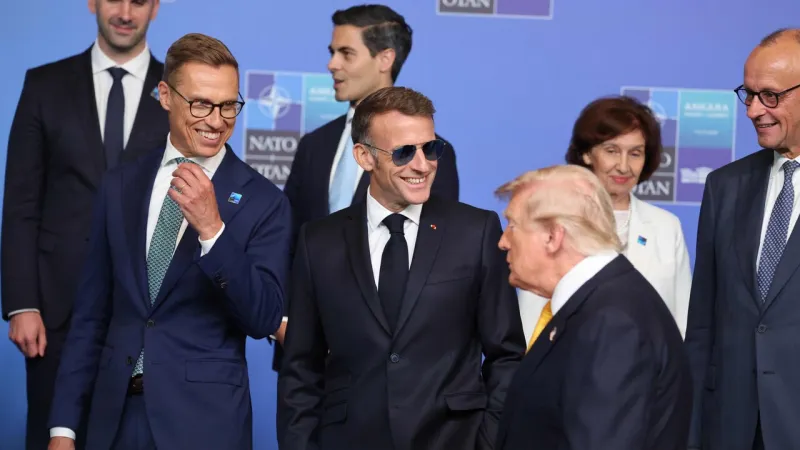
Ankara, Turkey – President Donald Trump delivered sharp criticisms against NATO and Italy regarding military base contributions today during a pivotal alliance summit, while French President Emmanuel Macron announced plans for future joint military exercises among "the willing" nations to bolster Ukraine's defenses. The stark divergence in tone underscored ongoing tensions within the Western alliance as leaders convened to address global security challenges, with Italian Prime Minister Giorgia Meloni separately reaffirming Italy's steadfast support for Kyiv in her meeting with Ukrainian President Volodymyr Zelensky.
President Trump articulated his frustration directly, stating, "I am angry with NATO, and Italy is doing badly on the bases." This assertion follows a consistent pattern of the President challenging allied nations to increase their defense spending and contributions, particularly concerning the financial burden of maintaining American military presence abroad.
The American leader extended his broad critiques beyond NATO, declaring, "With Spain, commercial relations are closed; it's a hopeless case." He also took aim at Iran, asserting that the nation is "sick and lying" and that "the ceasefire is over," without specifying which ceasefire he referred to, though presumably alluding to regional conflicts or previous diplomatic efforts. Conversely, President Trump offered a rare commendation, noting, "China has treated us well."
In contrast to President Trump's combative posture, President Macron signaled a renewed commitment to direct military support for Ukraine. His proposal for future joint exercises among "the willing for Kyiv" aims to enhance interoperability and readiness among nations prepared to intensify their backing for Ukraine against continued aggression. This initiative reflects a growing European resolve to independently strengthen Ukraine's defense capabilities.
Amidst these high-level discussions, Prime Minister Meloni met with President Zelensky, reiterating Italy's firm commitment. "Italy is firmly committed alongside Kyiv," Meloni reportedly stated, underscoring Italy's continued financial, humanitarian, and military assistance to Ukraine. This meeting highlighted the bilateral diplomatic efforts occurring concurrently with the broader NATO deliberations.
The summit's atmosphere was undoubtedly shaped by President Trump's long-standing skepticism regarding the alliance's burden-sharing. His remarks about Italy's contributions to military bases, specifically, echo earlier pronouncements questioning the equitable distribution of responsibilities among member states. These comments inevitably fuel discussions about NATO's future strategic direction and financial architecture.
Observers note that President Trump's expressions of NATO discontent have been a recurring theme throughout his presidency, often linked to the perceived underfunding of the alliance by other nations. His administration has consistently pushed for all members to meet the 2% of GDP defense spending target.
Prime Minister Meloni's steadfast commitment to Kyiv, reiterated during her meeting with President Zelensky, aligns with Italy's consistent stance since the full-scale invasion began. Her remarks affirm Italy's role as a key European partner in the international coalition supporting Ukrainian sovereignty, a position consistently communicated at previous gatherings, as evidenced by reports like Meloni Reaffirms Ukraine Support to Zelensky at Pivotal NATO Summit.
President Trump's sweeping criticisms, including the dramatic declaration regarding Spain's commercial relations, raise questions about potential shifts in US foreign policy and economic partnerships. Such pronouncements from the American head of state carry significant weight, impacting diplomatic relations and global trade dynamics. The assertion about Iran's ceasefire also introduces uncertainty into an already volatile Middle East.
Macron's initiative reflects a broader European desire to forge a more robust and autonomous defense capability, particularly in light of evolving geopolitical landscapes and varying perspectives on transatlantic security. The "willing for Kyiv" concept suggests a flexible coalition tailored to specific defense needs and capabilities, potentially complementing or operating in parallel with broader NATO efforts.
Historically, US presidents have at times expressed dissatisfaction with allied contributions, but President Trump's rhetoric has often been more direct and public. This approach regularly sparks intense debate within the alliance and among international policy analysts regarding the cohesion and long-term viability of NATO.
The Ankara Summit itself served as a crucial forum for these critical discussions. Reports confirm that President Trump used the opportunity to unleash fury at NATO, targeting Iran and Spain, which set a contentious tone for parts of the proceedings. The broader NATO demands made by his administration have been a central point of discussion among member states.
As the summit continues, the stark contrasts in allied approaches to global security and burden-sharing remain prominent. The outcomes of these discussions are poised to significantly influence the future trajectory of NATO, European defense strategies, and international alliances in a period of heightened geopolitical instability.