Edward DP Situmorang
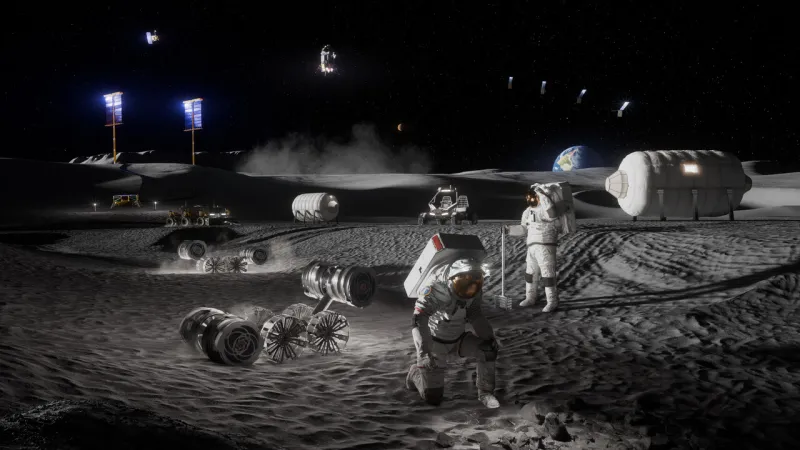
Paris — Leading scientists and metrology experts from around the globe are converging at an international conference on weights and measures, working to establish a universal standard for measuring time on the Moon. This critical endeavor aims to unify timekeeping for future lunar missions, ensuring precision in navigation, communication, and the complex logistics of potential human settlements.
The initiative addresses a fundamental challenge presented by the Moon's distinct gravitational field, which causes time to pass differently than on Earth. Establishing a coherent time standard is deemed essential before sustained human presence and advanced scientific operations can truly flourish on the lunar surface.
Alessandro Calonico, Geodesy and Geophysics Research Director at Italys National Metrology Research Institute, Inrim, indicated that a first vote on a proposed framework for this lunar time standard is anticipated shortly. This marks a significant step towards formalizing a critical piece of infrastructure for off-world exploration.
The necessity for a bespoke lunar time system stems directly from Albert Einsteins theory of relativity. Gravitational time dilation dictates that clocks on the Moon, experiencing slightly less gravity than on Earth, would run marginally faster. Over days, months, and years, these small discrepancies accumulate, posing significant problems for highly sensitive scientific instruments and synchronized mission operations.
Without a standardized approach, different space agencies and private entities operating on the Moon would likely adopt their own ad hoc timing systems. Such a fragmented approach could lead to substantial difficulties in coordinating activities, exchanging data, and ensuring the safety of autonomous systems and human explorers.
The discussions at the international conference highlight the broad scope of this challenge. Experts are evaluating various proposals, weighing the complexities of synchronizing lunar time with Earths Coordinated Universal Time (UTC), while also considering the unique requirements of a self-sustaining lunar ecosystem.
Historically, Earths UTC was painstakingly developed through decades of international cooperation, integrating atomic clocks worldwide. The effort to define a lunar equivalent, sometimes referred to as Coordinated Lunar Time (LTC), aims to leverage this past experience while innovating for the extraterrestrial environment.
This standardization effort is not merely theoretical; it has profound practical implications for the ambitious lunar programs currently underway, such as NASAs Artemis missions and various initiatives by China and other nations. Precision timing is paramount for everything from spacecraft rendezvous and docking maneuvers to the precise calibration of lunar observatories and resource extraction operations.
The global scientific community recognizes that a shared time standard is as fundamental to lunar development as common units of measurement for length or mass. It forms the invisible backbone for reliable infrastructure, facilitating everything from scientific experiments to the logistics of building a permanent moon base.
The implications extend to future lunar economies. As commercial interests grow on the Moon, including potential mining operations or space tourism, a unified time standard will be indispensable for legal contracts, financial transactions, and ensuring equitable resource allocation. It provides a foundational element for a nascent lunar society.
The imminent vote underscores the urgency and collective will within the international scientific community to address these foundational challenges proactively. The outcome will likely shape the trajectory of lunar exploration and settlement for decades to come.
Establishing this standard will also serve as a precedent for other celestial bodies. The lessons learned and the frameworks developed for the Moon could eventually inform efforts to standardize time on Mars or other destinations as humanity pushes further into the solar system. The universe of scientific measurement continues to expand, much like the search for habitable worlds.