Demian Sahputra
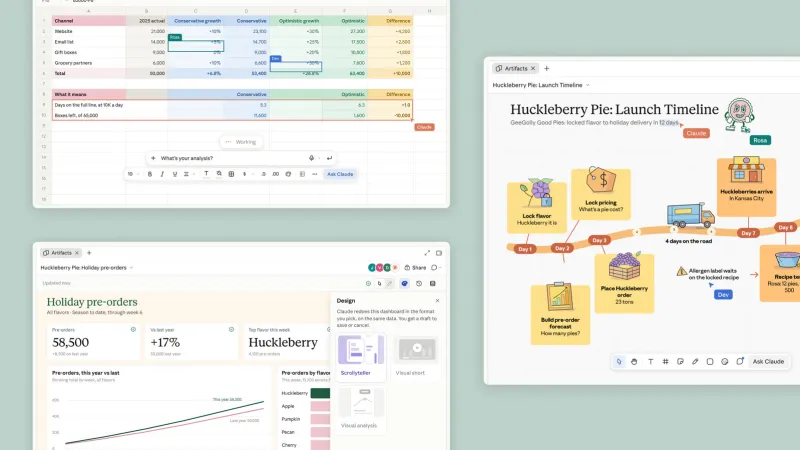
NEW YORK – Anthropic, a prominent artificial intelligence research company, recently unveiled Claude Sheets and an innovative whiteboard application, marking a significant escalation in its rivalry with technology titans Google and Microsoft within the burgeoning enterprise AI productivity sector. The strategic move positions Anthropic to capture a larger share of the market for advanced generative AI tools designed to enhance business operations and collaboration.
Claude Sheets introduces a powerful spreadsheet-like interface, harnessing the capabilities of Anthropic's Claude AI model to facilitate complex data analysis, financial modeling, and strategic planning. Users can leverage natural language prompts to manipulate data, generate insights, and automate routine analytical tasks, aiming to streamline workflows currently dominated by traditional spreadsheet software.
Complementing Claude Sheets, the newly launched whiteboard application offers a dynamic digital canvas for collaborative ideation and project planning. This tool integrates generative AI to assist teams in brainstorming, visualizing concepts, and structuring projects, providing an intelligent partner that can suggest improvements or generate content based on user input.
The introduction of these tools underscores Anthropic's ambitious strategy to differentiate itself in a highly competitive landscape. By offering bespoke AI applications tailored for specific business functions, the company seeks to challenge the broad ecosystem solutions provided by its larger competitors.
Google, an established leader in AI, continues to integrate its advanced models across its Workspace suite, offering features that enhance productivity for millions. The company has also made strides in specialized applications, as seen with its expansion of Rambler AI dictation to Pixel 10 devices, significantly boosting older phone capabilities. Google Expands Rambler AI Dictation to Pixel 10, Boosts Older Phones exemplifies its pervasive AI integration.
Microsoft, equally formidable, has deeply embedded its AI assistant, CoPilot, across its entire enterprise software portfolio, from Microsoft 365 to Dynamics 365. This pervasive integration provides users with AI-powered assistance for everything from email drafting to data visualization, setting a high bar for competitors.
The battle for supremacy in generative AI is intensifying, driven by rapid advancements in large language models and a growing demand for intelligent automation. Companies like Anthropic are crucial in pushing the boundaries of what AI can achieve, fostering an environment of continuous innovation.
Enterprises worldwide are increasingly seeking AI solutions that can deliver tangible improvements in efficiency, decision-making, and resource allocation. The market demands tools that are not only powerful but also intuitive and seamlessly integrated into existing business processes.
As AI tools become more sophisticated and integral to daily operations, ensuring their reliability and ethical deployment is paramount. Regulators and industry bodies are actively working to establish frameworks for AI oversight, with initiatives such as the one in New York establishing independent verification for AI models gaining traction. New York Establishes Independent Oversight for AI Model Verification highlights this crucial ongoing effort.
User experience remains a critical factor in the adoption of new AI technologies. For tools like Claude Sheets and the whiteboard app to succeed, they must offer not only advanced functionalities but also intuitive interfaces that minimize the learning curve for business professionals.
Data security and privacy concerns also loom large for enterprises considering the adoption of new AI tools. Providers must demonstrate robust safeguards to protect sensitive corporate information processed by their AI systems, a non-negotiable requirement for widespread trust.
The future trajectory of AI suggests a move beyond mere automation towards augmentation, where AI acts as a co-pilot for human creativity and strategic thought. Tools like those from Anthropic aim to facilitate this shift, empowering individuals and teams to achieve more complex outcomes.
These new offerings from Anthropic aim to redefine how professionals interact with data and collaborate on projects, potentially setting new benchmarks for productivity in the digital workplace. Their success will depend on user adoption, continuous innovation, and their ability to keep pace with the swift evolution of AI technology.
Ultimately, Anthropic's aggressive entry with Claude Sheets and its whiteboard application signifies a pivotal moment in the enterprise AI space. It underscores the belief that specialized, powerful AI solutions can effectively compete with the broad platforms offered by incumbent tech giants.