 Stefani Rindus
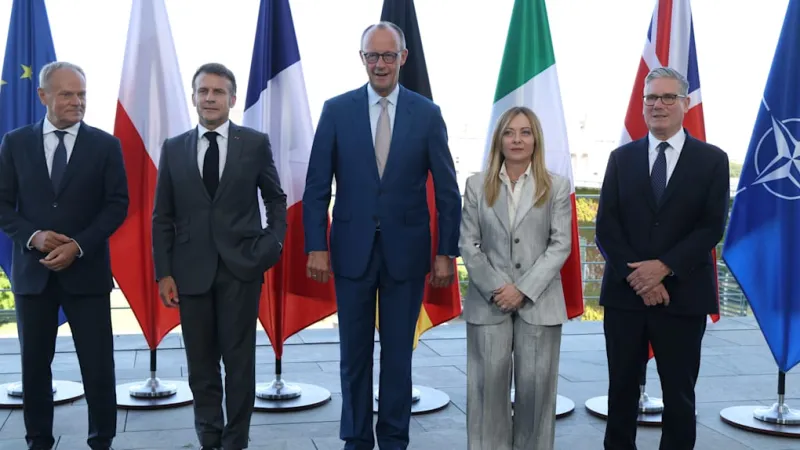
BERLIN - Europe's foremost heads of state and government have released a joint declaration from Berlin, a calculated pre-NATO summit maneuver designed to appease President Donald Trump. While meticulously crafted to resonate positively in Washington, a closer examination reveals these five messages are unlikely to sufficiently mollify the American leader, underscoring persistent transatlantic friction ahead of crucial alliance talks in 2026.
The statement, carefully worded by leading European nations, aimed to bridge the growing chasm between Washington and its European allies. For months, concerns have mounted across the continent regarding President Trump's long-standing skepticism towards collective defense commitments and the equitable distribution of financial burdens within the North Atlantic Treaty Organization.
European strategists had hoped the declaration would act as a diplomatic balm, addressing key American grievances without fundamentally altering the alliance's foundational principles. The collective effort underscores Europe's increasing recognition of the imperative to solidify transatlantic ties amidst evolving global security challenges.
However, sources close to the diplomatic discussions suggest that while the initiative signals a good faith effort, its substance may not meet the stringent demands often articulated by President Trump. The precise content of the five messages remains under wraps, but their general tenor reportedly focuses on reaffirming defense spending targets and enhancing European contributions to NATO operations.
President Trump has consistently advocated for a more equitable burden-sharing model, frequently criticizing member states for failing to meet the 2% of GDP defense spending target. His administration has linked American commitment to these financial metrics, signaling a transactional approach that often unsettles European capitals.
This latest European initiative is seen as a direct response to those pressures. The leaders sought to demonstrate unity and resolve, projecting an image of proactive engagement rather than reactive concession. Yet, analysts contend that mere reiterations of existing commitments, however well-intentioned, might not be enough to shift the American President's deeply entrenched views.
Diplomatic observers recall previous instances where European efforts to reassure Washington have met with lukewarm reception. The current declaration, while ambitious in its intent, faces the formidable task of overcoming years of accumulated distrust and differing strategic priorities. The challenge lies in translating rhetorical commitments into tangible, impactful policy shifts that resonate in the Oval Office.
The upcoming NATO summit is poised to be a pivotal moment for the alliance. With Russia's continued aggression and emerging global threats, a unified front is more critical than ever. Yet, the pre-summit posturing suggests that achieving genuine consensus on NATO's future direction will require more than carefully crafted statements.
Many European leaders, including Italian Prime Minister Giorgia Meloni, have actively championed a stronger European role within NATO, recognizing the necessity of increased self-reliance and shared responsibility. Prime Minister Meloni previously urged a stronger European NATO role ahead of crucial summit, articulating a vision for a more robust European defense identity within the alliance framework.
This declaration thus represents a delicate balancing act: an attempt to assuage American concerns while simultaneously bolstering European strategic autonomy. The effectiveness of this approach will ultimately be measured by the reception it receives in Washington and its impact on the tenor of the forthcoming summit discussions.
Geopolitical experts indicate that the declaration likely touches upon areas such as increased military interoperability, a renewed focus on emerging threats, and potentially, specific contributions to NATO's eastern flank. However, without novel, substantial commitments, the declarations risk being perceived as largely symbolic.
The ongoing push for NATO renewal amid Washington rift highlights the deep structural challenges confronting the alliance. European leaders are keenly aware that the long-term viability of NATO hinges on more than just financial contributions; it requires a shared strategic vision and unwavering political will from all members, including its largest contributor.
The current climate demands a profound reassessment of the transatlantic bond. While the Berlin declaration attempts to signal unity and commitment, the true test will be whether it catalyzes a genuine shift in President Trump's outlook, or if it merely underscores the persistent divergence between American and European security paradigms.
The declaration's limited immediate impact suggests that the path to a fully reconciled transatlantic alliance remains arduous. The coming weeks, leading up to and during the NATO summit, will reveal whether this diplomatic overture can truly pave the way for a more harmonious future, or if deeper rifts are destined to widen.