 Dorry Archiles
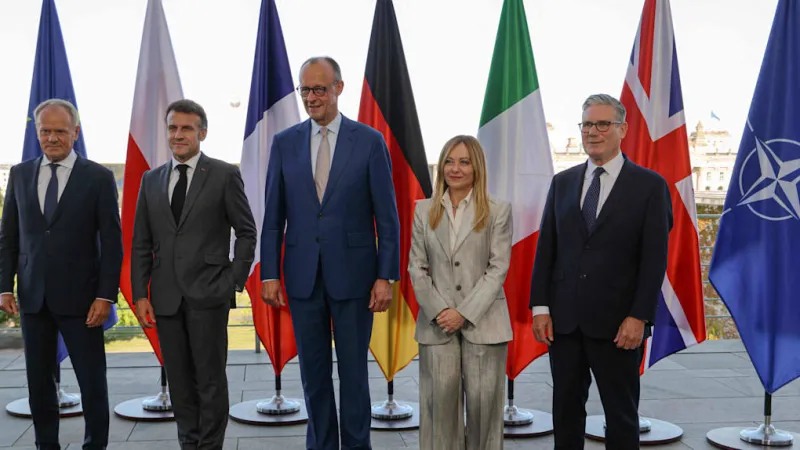
Berlin – Europe's leading heads of state and government convened in the German capital today to forge a unified stance ahead of the critical NATO summit in Ankara. Their concerted effort aims to project solidarity, intensify support for Ukraine, and reinforce the European pillar of the North Atlantic Treaty Organization, even as discernible tensions persist with the administration of President Donald Trump in Washington.
The preparatory discussions underscored a collective determination among European leaders to present a cohesive front. This strategic alignment is crucial not only for internal alliance dynamics but also for demonstrating unwavering resolve against external pressures and evolving global security challenges.
The transatlantic alliance has experienced palpable strain in recent years, largely attributed to President Donald Trump's consistent questioning of allied defense spending and the fundamental purpose of NATO. European officials have frequently expressed concern over what they perceive as an unpredictable foreign policy stance from Washington, driving the urgency for greater European self-reliance within the alliance framework.
A central component of the European leaders' agenda involved reaffirming and expanding their commitment to Ukraine. As the conflict with Russia continues, the need for sustained and intensified military and financial assistance to Kyiv remains paramount. Discussions focused on streamlining aid mechanisms and ensuring long-term support, despite reports of Russian fuel rationing in response to Ukrainian attacks.
Strengthening the European pillar signifies a strategic shift toward greater burden-sharing and enhanced capabilities among European NATO members. This initiative, championed by various leaders including Italian Prime Minister Giorgia Meloni, who has urged a stronger European NATO role, seeks to ensure that Europe can effectively address its own security concerns while contributing robustly to collective defense.
Such an emphasis on European autonomy within NATO represents an evolution from the alliance's Cold War origins, where the United States was undeniably the dominant force. Contemporary geopolitical realities demand a more balanced and collaborative approach, where European nations take on greater responsibility for their collective security.
Efforts to boost European defense capabilities are already visible across the continent. Nations are increasing their military budgets, investing in modern equipment, and enhancing readiness. The German Bundeswehr has seen a surge in military service applications, reflecting a renewed national commitment to defense. This growing capacity is intended to complement, not supplant, the essential contributions of the United States, including the extensive US military footprint in Italy and other strategic locations.
The upcoming Ankara summit is expected to be a pivotal moment for NATO. European leaders aim to present a unified front, not only to internal and external adversaries but also to demonstrate their capacity for strategic coherence independent of, yet in coordination with, Washington. This proactive stance is seen as vital for the alliance's long-term resilience and relevance.
Challenges abound, however. Achieving complete consensus among diverse European interests, navigating budgetary constraints, and managing the delicate balance of transatlantic relations will require astute diplomacy and unwavering political will. The success of the Ankara summit will largely depend on the ability of these leaders to translate their Berlin coordination into tangible, collective actions.
Ultimately, the European strategy signals a determination to uphold the foundational principles of NATO while adapting to a multipolar world. It is a nuanced attempt to strengthen the alliance from within, ensuring its continued efficacy as the cornerstone of Euro-Atlantic security amidst a complex geopolitical landscape.