Chandra Wijayanto
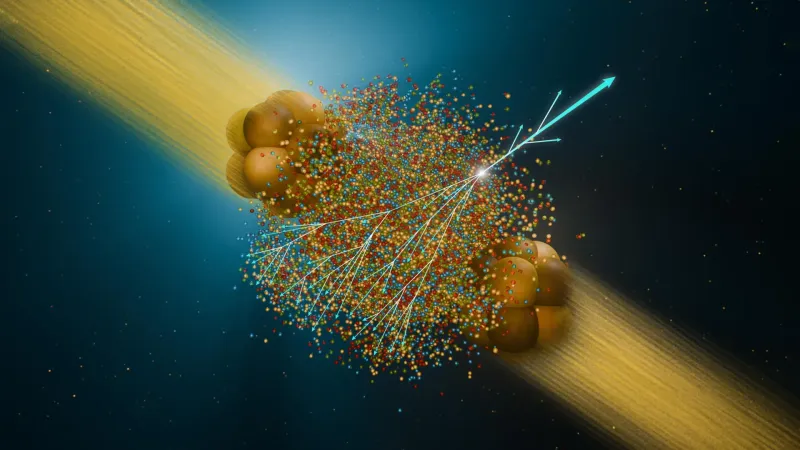
Scientists have successfully recreated a primordial state of matter, mirroring conditions from the dawn of the universe, by accelerating and colliding oxygen nuclei at near light speeds in controlled experiments. This groundbreaking research challenges long-held assumptions, demonstrating that this exotic substance can emerge from significantly smaller and lower-energy collisions than previously believed, fundamentally reshaping our understanding of early-universe physics.
For decades, physicists have strived to understand the universe's initial moments, mere microseconds after the Big Bang. During this fleeting epoch, matter existed not as atoms or protons, but as a dense, superheated soup of quarks and gluons, known as quark-gluon plasma. Recreating this primordial matter in laboratories offers a unique window into these extreme conditions.
Historically, the formation of quark-gluon plasma required the collision of much heavier atomic nuclei, such as lead or gold, propelled to immense energies in colossal accelerators. These prior experiments, often conducted at facilities like CERN or Brookhaven National Laboratory, provided foundational data on the properties of this exotic state.
The new findings, however, reveal a surprising versatility in primordial matter formation. Researchers observed that oxygen nuclei, comparatively lighter than the previously used heavy ions, were capable of generating this quark-gluon plasma when collided at velocities approaching the speed of light. This unexpected result broadens the scope of experiments that can explore the universe's infancy.
The implication of these smaller, lower-energy collisions is profound. It suggests that the conditions necessary for creating primordial matter might be more ubiquitous, and therefore more accessible for study, than initially theorized. This could democratize access to this type of fundamental research, potentially allowing more facilities to contribute to our understanding of the Big Bang.
This discovery directly challenges certain established theoretical models of quantum chromodynamics, the theory governing the strong nuclear force that binds quarks and gluons. It forces physicists to re-evaluate the critical energy thresholds and particle densities required for the phase transition from hadronic matter to quark-gluon plasma.
The research provides fresh avenues for exploration into the universe's early thermal history and its subsequent evolution. By studying how primordial matter forms and behaves under these newly observed conditions, scientists can gain deeper insights into the initial expansion and cooling of the cosmos, as well as the formation of the first elementary particles.
Further experiments are anticipated to probe the precise properties of the quark-gluon plasma generated from oxygen collisions. These investigations will aim to quantify its temperature, density, and viscosity, comparing them against existing data derived from heavier ion collisions to discern any potential differences or commonalities.
The findings resonate with other astronomical observations that challenge existing paradigms, much like recent discoveries that have seen White Dwarfs Display Dazzling Hues, Challenging Stellar Assumptions regarding stellar evolution. Both underscore the dynamic nature of scientific inquiry and the continuous refinement of our cosmic understanding.
Ultimately, this breakthrough in recreating primordial matter from oxygen nuclei collisions not only expands the practical boundaries of experimental particle physics but also deepens humanitys profound quest to comprehend the very genesis of our universe. It marks another significant step in deciphering the enigmatic secrets held within the Big Bang.