Demian Sahputra
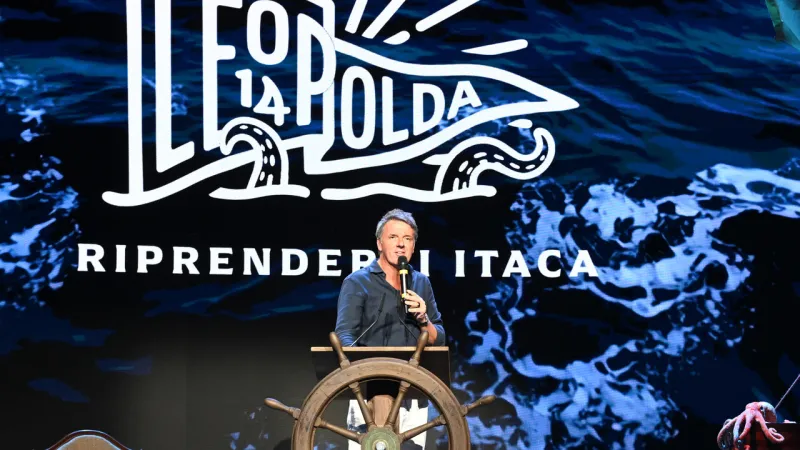
Rome – Matteo Renzi, leader of the centrist Italia Viva party, issued a forceful political ultimatum this week to Prime Minister Giorgia Meloni, stating she faces a stark choice: either ascend to the Quirinale presidential palace or resign from her post. During a strategic address, Renzi called for a unified front among Italy's moderate and centrist parties, including elements within Forza Italia, to collectively "win" against the current government and initiate a new political chapter. He explicitly ruled out any future collaboration with Giuseppe Conte, particularly concerning the influential Interior Ministry.
Renzi's pronouncement underscores growing tensions within the Italian political landscape, signaling a concerted effort by the opposition to capitalize on perceived weaknesses of the Meloni administration. His challenge regarding the Quirinale hints at a hypothetical scenario where Meloni might seek a higher, less executive role, or be forced into a situation requiring a governmental reshuffle or early elections.
The former Prime Minister's appeal for unity targets a specific segment of the political spectrum. He urged Forza Italia and other moderate factions to coalesce, arguing that fragmented opposition efforts have historically failed to dislodge incumbent governments. This call for a broader coalition reflects a strategic move to consolidate power against the ruling right-wing alliance.
"This time, united, we win," Renzi reportedly declared, emphasizing his conviction that a cohesive opposition holds the key to electoral success. This statement serves as a rallying cry, seeking to bridge ideological gaps among parties that currently stand in opposition to the governing coalition.
A significant aspect of Renzi's strategy involves unequivocally rejecting any future political alliance with Giuseppe Conte, the former Prime Minister and leader of the Five Star Movement. Renzi's stance suggests a deep-seated distrust or fundamental disagreement with Conte's political trajectory and policy positions.
Renzi's statement, "Conte? Never again [with] Salvini at the Interior Ministry," serves a dual purpose. It firmly distances his proposed moderate alliance from any future collaboration with Giuseppe Conte while simultaneously expressing a clear aversion to Matteo Salvini returning to a powerful portfolio like the Viminale. This highlights Renzi's strategic objective to build a distinct political bloc free from what he perceives as past ideological entanglements.
The call for unity echoes previous attempts by centrist forces to carve out a viable third pole in Italian politics, often struggling to gain significant traction against the two dominant blocs of the center-right and center-left. Renzi's current push reflects a renewed ambition to overcome these historical challenges by presenting a unified, moderate alternative.
Prime Minister Giorgia Meloni leads a right-wing coalition that has largely maintained public support since assuming office. Her administration has navigated various domestic and international challenges, including economic pressures and geopolitical shifts. Renzi's direct challenge aims to disrupt this perceived stability and force a re-evaluation of her government's mandate.
The reference to the Quirinale, the official residence of the President of Italy, invokes the highest office in the Republic. President Sergio Mattarella currently occupies this role, serving as a guarantor of the constitution. Renzi's suggestion that Meloni could "go to the Quirinale" implies a significant political maneuver, possibly a resignation from the premiership to seek the presidency, or an insinuation that her government's instability could lead to presidential intervention.
Renzi's direct appeal to Forza Italia is particularly noteworthy. As a key component of Meloni's ruling coalition, a significant shift in Forza Italia's alignment or internal dissent could profoundly destabilize the government. This move by Renzi seeks to exploit any existing fault lines within the center-right alliance.
The current political climate in Italy is characterized by a complex interplay of party loyalties, shifting alliances, and public sentiment. Renzi's intervention adds another layer to this intricate web, potentially triggering new rounds of negotiations and realignments among the various political actors.
Analysts suggest that such a direct challenge, coupled with a call for opposition unity, could pave the way for early elections or a period of intense political instability if Meloni's government faces significant internal or external pressures. The outcome hinges on the willingness of other moderate parties to embrace Renzi's vision for a consolidated opposition.
President Sergio Mattarella often plays a vital role in Italian political crises, facilitating government formation or calling for new elections when a stable majority cannot be formed. Any move towards the Quirinale by Meloni, as suggested by Renzi, would fall under the purview of presidential decision-making. As noted in articles such as Mattarella Evokes Saint Francis for Peace, Zuppi Decries Arms, President Mattarella consistently emphasizes national unity and constitutional stability.