 Stefani Rindus
BERLIN – Germany's Christian Democratic Union (CDU) confronts what a leading party figure terms its most profound crisis in recent memory, a predicament born from persistent internal personnel disputes and mounting questions about its fundamental capacity to govern. Christian Bäumler, deputy chairman of the Christian Democratic Employees Association (CDA), delivered a stark assessment, emphasizing the critical need for the party to restore public trust.
Bäumler minced no words in his critique, stating directly that the party's current struggles extend beyond mere political differences. "It is about credibility, about the ability to lead a country. We must become significantly better," he asserted, underscoring the gravity of the situation facing one of Germany's traditionally dominant political forces.
The CDU crisis has simmered for months, exacerbated by a series of high-profile internal conflicts and disagreements over strategic direction. These power struggles have reportedly paralyzed decision-making processes and eroded the party's coherent public image, drawing sharp criticism from both within its ranks and from external observers.
Observers point to the ongoing battle for influence among key figures as a primary catalyst for the current instability. Such internal friction has historically tested the CDU, but Bäumler's declaration signals a new low point, suggesting the party's very identity and future leadership role are now in jeopardy.
The party's current predicament is particularly notable given its historical role as a bedrock of German politics, having produced numerous chancellors and guided the nation through pivotal moments. The current environment of disunity threatens to undermine its electoral prospects and its broader political authority.
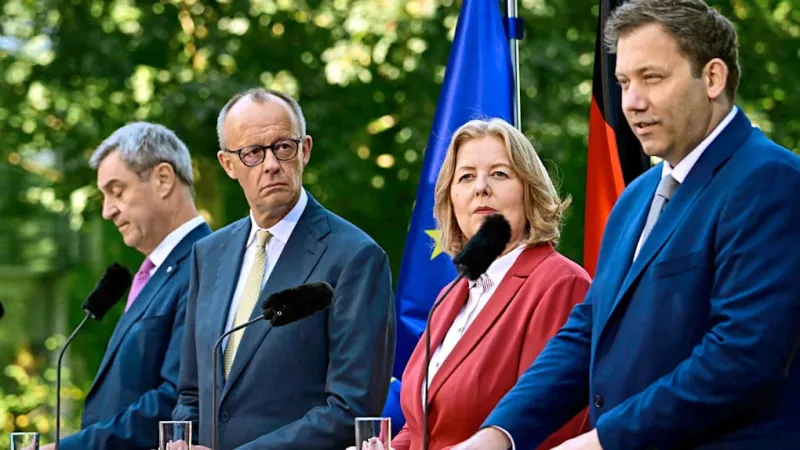
Efforts to foster unity have met with limited success. For instance, party leader Friedrich Merz has frequently called for cohesion, particularly following challenging internal elections, as documented in reports such as Merz Seeks Unity Amid Persistent CDU Fractures After Frei Election. However, these appeals appear to have done little to quell the underlying tensions.
The nature of the personnel disputes remains largely behind closed doors, yet their public manifestation has led to speculation regarding policy shifts and ideological divisions. Some within the party advocate for a more conservative stance, while others push for a centrist renewal, creating a palpable ideological rift.
The fallout from these internal squabbles extends beyond party headquarters, impacting public perception and trust. Polling data suggests a decline in voter confidence in the CDU's leadership capabilities, a worrying trend for a party aspiring to challenge the current governing coalition effectively.
Even specific policy debates, such as those concerning social welfare and pension rights for East German citizens, as highlighted in CDU Leaders Demand East German Pension Rights Protected, reveal underlying tensions that contribute to the broader sense of internal disarray. These discussions often become proxies for larger power dynamics within the party.
Bäumler's call for improvement is not merely a plea for internal peace but a demand for a fundamental re-evaluation of the CDU's approach to governance and public engagement. He implies that without significant changes, the party risks alienating its traditional voter base and failing to attract new support.
The Christian Democratic Employees Association, which Bäumler helps lead, represents the social conservative and labor-oriented wing of the CDU, giving his words particular weight. Their perspective often reflects the concerns of a crucial demographic within the party's broader electorate.
As Germany approaches future electoral cycles, the CDU faces the daunting task of mending its internal divisions and presenting a united front. The path forward demands not just rhetoric of unity, but concrete actions to address the core issues of credibility and leadership effectiveness.
The political landscape in Germany has grown increasingly fragmented, with the rise of smaller parties and shifting voter allegiances. In this environment, a fractured CDU finds itself ill-equipped to provide the strong, stable opposition or governmental alternative that many voters seek.
The imperative for the CDU now is clear: to move beyond introspection and internal squabbling towards a renewed vision that can inspire confidence across the nation. Bäumler's critique serves as a potent warning that the stakes are higher than ever for the party's future.
Without a swift and decisive pivot, the CDU risks cementing a perception of internal chaos, thereby ceding further ground to political rivals and prolonging a period of unprecedented weakness. The coming months will be critical in determining whether the party can heed Bäumler's admonition and regain its footing.