 Angela Stefani
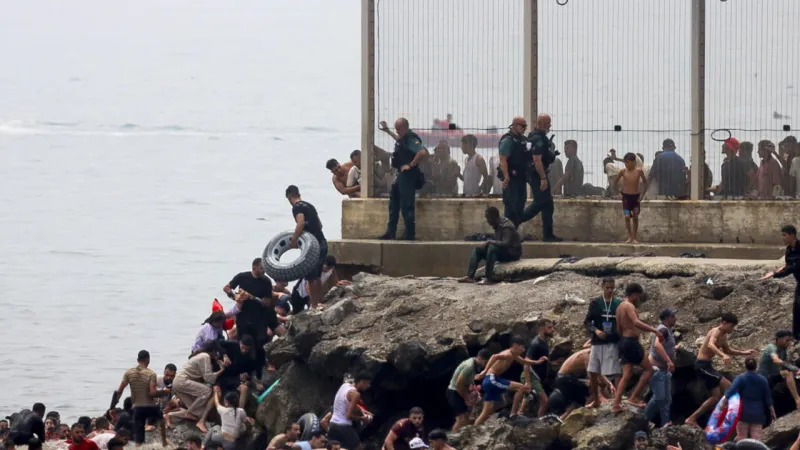
Thousands of migrants, many of them children, have overwhelmed the borders of Spains North African enclave of Ceuta in recent days, swimming ashore from neighboring Morocco. This unprecedented influx has tragically claimed the lives of at least nine individuals by drowning, prompting the Spanish government to deploy its army and triggering an evaluation by Italy regarding the potential suspension of the Schengen agreement.
The humanitarian crisis unfolded with alarming speed, as an estimated 10,000 people, primarily from Morocco and sub-Saharan Africa, made their perilous journey across the Strait of Gibraltar. The sheer volume of arrivals strained emergency services and border patrols, transforming the tranquil coastline into a scene of desperation and chaos.
Spanish Prime Minister Pedro Sanchez swiftly condemned the mass arrival, emphasizing Spains commitment to securing its borders while ensuring humane treatment for those reaching its territory. He announced the deployment of additional military units to bolster border defenses and assist law enforcement in managing the overwhelming situation.
The deployment includes elements of the Spanish Army and Civil Guard, tasked with reinforcing patrols along the maritime and land borders separating Ceuta from Morocco. Their immediate priorities involve controlling further entries and ensuring the safety of all individuals, including vulnerable minors, caught in the desperate surge.
The human toll of the crossing remains a grave concern. Rescuers have recovered the bodies of at least nine individuals, victims of the treacherous currents and the exhaustion of the long swim. Aid agencies and medical personnel are working tirelessly to provide assistance to the thousands who have reached Ceuta, many suffering from hypothermia, shock, and injuries.
Beyond the immediate humanitarian response, the incident has ignited significant diplomatic tensions between Spain and Morocco. Spanish officials implicitly criticized Morocco for its perceived inaction in controlling its side of the border, suggesting a deliberate easing of controls amidst broader diplomatic disagreements between the two nations.
On the European front, the Ceuta migrant crisis reverberated through the capitals of the European Union. Italy, a nation frequently at the forefront of migration challenges in the Mediterranean, voiced profound concerns. Italian officials indicated they are actively evaluating the possibility of suspending the Schengen agreement, a move that would represent a significant escalation of political dissatisfaction with current EU border policies.
Suspension of the Schengen agreement, which allows for free movement across much of Europe without internal border checks, would have far-reaching implications. Such a decision would signal a deep crisis in European solidarity and potentially lead to a fragmentation of the EUs common migration and asylum policy.
The EUs external border, represented by enclaves like Ceuta and Melilla, continues to face immense pressure from migratory flows. These Spanish territories in North Africa have historically been flashpoints, but the recent events mark an unprecedented scale of unauthorized entry, challenging existing protocols and resources.
International organizations and humanitarian groups have called for increased European solidarity and a comprehensive, rights-based approach to migration management. They stress the need for safe and legal pathways for asylum seekers, alongside robust support for frontline states like Spain and Italy.
The ongoing crisis underscores the complex interplay of geopolitical tensions, humanitarian imperatives, and the evolving dynamics of global migration. As Spain grapples with the immediate aftermath and Italy contemplates its policy response, the events in Ceuta serve as a stark reminder of the urgent need for a unified and effective European strategy on migration.
The Spanish government maintains that its primary objective is to restore order and ensure the security of its borders while upholding humanitarian principles. The long-term implications for Spanish-Moroccan relations and the future of EU migration policy are likely to remain central topics in international discourse for the foreseeable future.