 Angel Doris
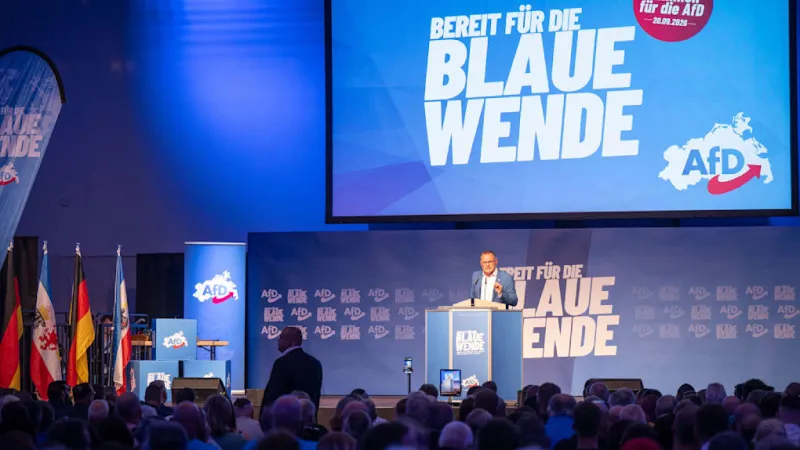
BERLIN – As Germany approaches a pivotal state election in Mecklenburg-Vorpommern, the Alternative for Germany (AfD) has escalated its criticism of Berlin's financial support for Ukraine, with party leader Tino Chrupalla making incendiary remarks about President Volodymyr Zelenskyy. Simultaneously, prominent AfD figure Ulrich Siegmund announced a definitive timeline for the party to form its first regional government, signaling a potentially significant shift in the nation's political landscape.
Chrupalla, speaking at a campaign event, lambasted the substantial aid packages directed towards Kyiv, asserting, "Unfathomable sums are being spent so Zelenskyy can sit on a golden toilet." His comments, delivered just days before voters head to the polls in Mecklenburg-Vorpommern, underscore the AfD's consistent opposition to Germany's current foreign policy and its financial commitments to Ukraine.
The AfD has long advocated for a reevaluation of Germany's stance on the conflict in Ukraine, frequently questioning the efficacy and necessity of military and financial assistance to Kyiv. The party's rhetoric often resonates with a segment of the electorate concerned about domestic economic pressures and resource allocation, positioning itself as the voice of a disaffected populace.
Adding to the party's pre-election momentum, Ulrich Siegmund, a key figure within the AfD and recently an election winner in another regional context, unveiled a strategic blueprint for the formation of the party's first state government. Siegmund's announcement, delivered with a tone of confident expectation, outlines concrete steps and a timeframe for the AfD to assume executive power in a German state.
The prospect of an AfD-led government, even at a regional level, marks a critical juncture for German democracy. Traditionally, mainstream parties have upheld a cordon sanitaire, refusing to enter into coalitions with the far-right party. Siegmund's declaration suggests an increasing confidence within the AfD that this barrier is nearing collapse, particularly in eastern German states where the party enjoys strong support.
The state election in Mecklenburg-Vorpommern is therefore imbued with heightened significance. While polls vary, the AfD consistently performs strongly in the region, fueling speculation about coalition possibilities or the potential for a minority government supported by other parties from the sidelines. The outcome will be closely watched as a bellwether for national political trends.
Mainstream parties, including Chancellor Olaf Scholz's Social Democrats (SPD) and the opposition Christian Democratic Union (CDU), have swiftly condemned Chrupalla's comments and reiterated their commitment to supporting Ukraine. The CDU, under Chairman Friedrich Merz, faces its own challenges, as a poor showing in regional elections could trigger internal party discussions, potentially leading to a "reset" for the party. Such outcomes are detailed in analyses such as CDU "Reset" Looms If Mecklenburg-Vorpommern Vote Fails, Merz Future Unclear.
Chairman Merz has been working to consolidate CDU unity amidst various regional and national challenges. Discussions about the party's future and leadership often intensify around crucial electoral contests. Recent reports highlighted how Merz "confronts internal critics, bolsters CDU unity amid Berlin vote," underscoring the ongoing political maneuvering within the traditional conservative bloc.
Public sentiment regarding Germany's extensive financial and military aid to Ukraine remains complex. While a significant portion of the population supports the assistance, citing humanitarian and strategic imperatives, others express fatigue or concern over the economic burden. The AfD actively capitalizes on this divide, using strong language to articulate its dissenting view.
The AfD's long-term strategy appears to involve chipping away at the established political order, state by state. By demonstrating an ability to govern, even regionally, the party aims to normalize its presence and dismantle the political consensus that has largely excluded it from executive power since its inception.
Should the AfD succeed in forming a government, even in a minority capacity, it would undeniably alter Germany's political landscape. Such a development could encourage other regional AfD branches and further challenge the resolve of established parties to maintain their collaborative boycott, potentially leading to a broader political realignment in Germany.
Internationally, the rise of the AfD continues to draw scrutiny. Its Eurosceptic and anti-immigration stances, coupled with its recent criticisms of Ukraine policy, position it outside the mainstream European political consensus. A significant electoral gain would send ripples across the European Union, impacting perceptions of Germany's internal stability and its foreign policy direction.
The coming days before the Mecklenburg-Vorpommern election are set to be charged with intense political rhetoric and campaigning. The statements by Chrupalla and Siegmund serve not just as campaign slogans but as clear indicators of the AfD's ambition to move from a protest party to a governing force, a transformation that promises to test the resilience of Germany's democratic institutions.