 Stefani Rindus
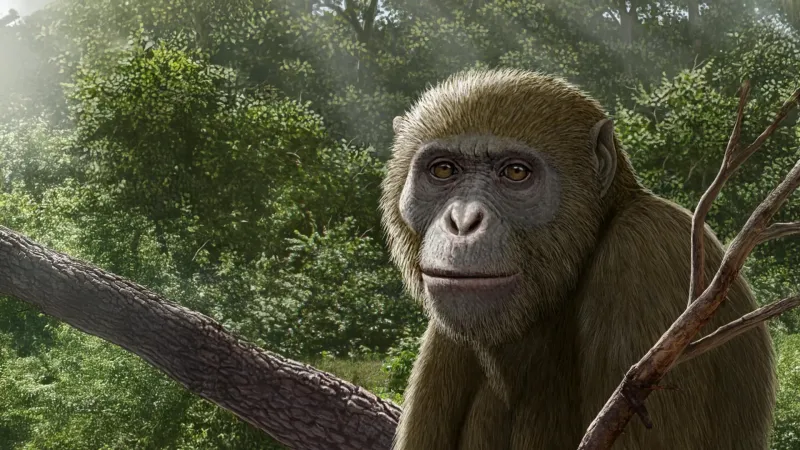
Cairo, Egypt – A 17- to 18-million-year-old ape fossil unearthed in Egypt has dramatically reshaped scientific understanding of where the ancestors of humans and other modern apes first evolved. This pivotal discovery now proposes North Africa and the Middle East as the potential cradle of modern ape evolution, challenging decades of established anthropological theory that primarily focused on East Africa as the ancestral homeland.
For generations, paleoanthropologists largely concurred that the earliest ancestors of hominoids, encompassing great apes and humans, emerged from East African landscapes. This hypothesis was bolstered by significant fossil finds across countries like Ethiopia, Kenya, and Tanzania, painting a compelling picture of a localized evolutionary hotspot.
The newly discovered ancient ape fossil, though specific details of its taxonomy are still emerging, carries immense chronological weight. Its age, spanning 17 to 18 million years, places it squarely within a critical period for primate diversification, offering an unprecedented window into early ape dispersal and adaptation.
This revelation compels researchers to reconsider migratory patterns and environmental conditions that might have influenced early primate development. The arid and diverse ecosystems of North Africa and the Middle East may have harbored conditions conducive to the evolutionary divergences that ultimately led to modern ape lineages.
The shift in geographic focus from East Africa to regions further north introduces a new dimension to the story of how our primate relatives spread across continents. It suggests a more complex, possibly multifocal, origin scenario rather than a singular, universally accepted point of genesis.
Scientists are now meticulously re-examining existing fossil records from various regions, seeking corroborating evidence or overlooked nuances that align with this revised perspective. This process involves sophisticated analyses of geological strata, comparative anatomy, and genetic markers where applicable, pushing the boundaries of current research methodologies.
The rigorous scientific process behind such pronouncements involves extensive fieldwork, advanced radiometric dating techniques, and comparative morphological studies. These efforts aim to precisely situate the fossil within the broader tree of life and establish its evolutionary relationship to both ancestral and modern ape groups.
Experts within the paleoanthropological community have reacted with a mix of intrigue and cautious optimism. While acknowledging the profound implications, they emphasize the need for further discoveries and validation to solidify this revolutionary hypothesis. The scientific discourse promises to be robust and illuminating in the coming years.
This discovery also underscores the critical importance of sustained exploration in regions previously considered peripheral to the main narratives of human evolution. It opens vast new territories for future paleontological expeditions, potentially unearthing further evidence to refine or redefine our understanding.
Understanding these ancient evolutionary pathways is not merely an academic exercise; it profoundly impacts our comprehension of biological diversity and the deep history of life on Earth. Such foundational discoveries remind us that even the most established scientific narratives are subject to revision with new, compelling evidence.
This re-evaluation of ancient history echoes other recent scientific breakthroughs, such as new findings on Magma Reveals Earths Deep Oxygen Cache, Reshaping Atmospheric History, which similarly compel us to reconsider long-accepted geological timelines and planetary processes.
The implications extend beyond just geographic location. Researchers will also explore how ecological pressures, climate shifts, and interactions with other species in North Africa and the Middle East might have shaped the unique adaptive traits seen in early apes.
While a complete picture remains elusive, the Egyptian ancient ape fossil has provided a crucial missing piece, or at least a powerful counter-narrative, that will stimulate fresh inquiries and potentially lead to a more comprehensive account of ape and human origins. It highlights the dynamic nature of scientific discovery, where breakthroughs can swiftly alter prevailing paradigms.
The scientific community anticipates robust debate and further data collection, recognizing that such a significant shift requires extensive verification. This commitment to empirical evidence ensures the integrity of the evolutionary narrative as it continues to unfold.