 Angela Stefani
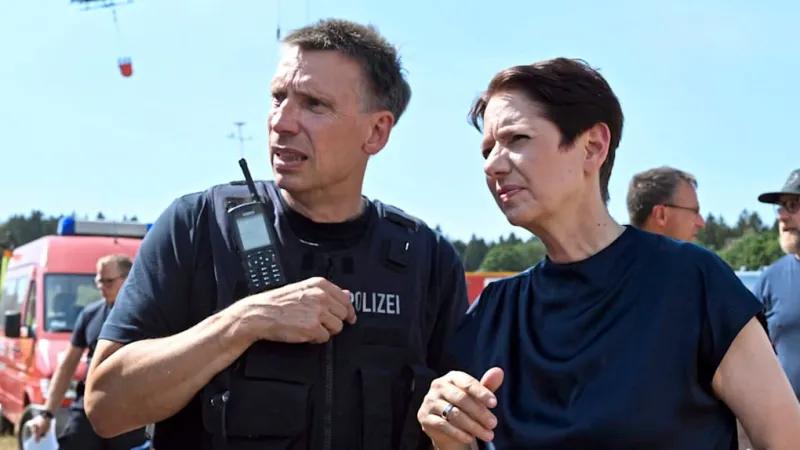
HÜRTGENWALD, Germany – A devastating wildfire continues to consume vast swathes of forest in the Eifel region near Hürtgenwald, keeping emergency services in constant deployment as a prominent German minister vows a comprehensive investigation into the blaze's origins, stating pointedly that “a forest does not ignite by itself.” The ongoing inferno has prompted high-level political engagement, with Minister-President Hendrik Wust expected to assess the situation firsthand and the Chancellor having contacted local authorities.
The large-scale blaze, which has affected several square kilometers of dense woodland, presents formidable challenges for firefighters and support personnel. The relentless flames have turned parts of the picturesque Eifel landscape into scorched earth, threatening local communities and biodiversity.
Emergency crews, comprising hundreds of firefighters from various regional departments, have been battling the inferno for days without respite. Difficult terrain, shifting winds, and exceptionally dry conditions have compounded their efforts to establish effective containment lines and bring the situation under control.
The unnamed minister's strong statement underscores a growing suspicion among officials regarding the fire's genesis. Her assertion that “a forest does not ignite by itself” signals a clear intent to look beyond natural causes, hinting at possible human negligence or even deliberate arson as the catalyst for the destruction.
This immediate call for an inquiry comes as initial assessments suggest the fire did not originate from typical natural phenomena such as lightning strikes. Investigators will now scrutinize potential ignition points and eyewitness accounts in their quest for answers, recognizing the profound implications of a human-caused event.
Minister-President Hendrik Wust of North Rhine-Westphalia is scheduled to visit the affected areas, demonstrating the regional government's commitment to the crisis. His presence on site is crucial for coordinating state-level resources and providing direct support to the beleaguered emergency personnel. This visit follows previous reports that Wüst Visits Impact Zone to gain firsthand insight into the unfolding disaster.
Further emphasizing the national scope of the crisis, the Chancellor recently engaged in discussions with the District Administrator of Duren, whose jurisdiction includes parts of the affected Hürtgenwald. This high-level communication highlights the federal government's concern and readiness to offer assistance, signaling how Political Leaders Mobilize Amid Prolonged Threat when such disasters strike.
Beyond Hürtgenwald, reports confirm that other regions across Germany are also grappling with significant wildfires, exacerbating the strain on national emergency resources. The synchronized outbreaks raise questions about widespread environmental factors, likely exacerbated by prolonged periods of drought and rising temperatures.
The ecological damage from the Eifel wildfire is projected to be extensive, impacting sensitive ecosystems, wildlife habitats, and the region's crucial role as a natural carbon sink. Reforestation efforts, should they become necessary, represent a monumental task that could span decades.
Local residents, many of whom reside perilously close to the fire lines, remain on high alert. Authorities have issued evacuation advisories in some areas, preparing for potential shifts in wind direction that could rapidly alter the fire's trajectory and threaten residential zones.
The financial toll of the continuous firefighting operations, combined with the long-term costs of environmental rehabilitation and potential property damage, will undoubtedly run into millions of euros. These economic consequences underscore the urgent need for robust prevention strategies and effective rapid response mechanisms.
As the investigation into the Eifel wildfire's cause intensifies, local law enforcement agencies and environmental crime units are expected to collaborate closely, leveraging forensic evidence and witness statements. Should arson or criminal negligence be confirmed, authorities are prepared to pursue legal action against those responsible to the fullest extent of the law.
This incident serves as a stark reminder of the escalating threat of wildfires in Europe, often exacerbated by climate change and human activity. Experts warn that without concerted efforts in prevention and sustainable land management, such devastating events may become increasingly commonplace.