 Debby Wijaya
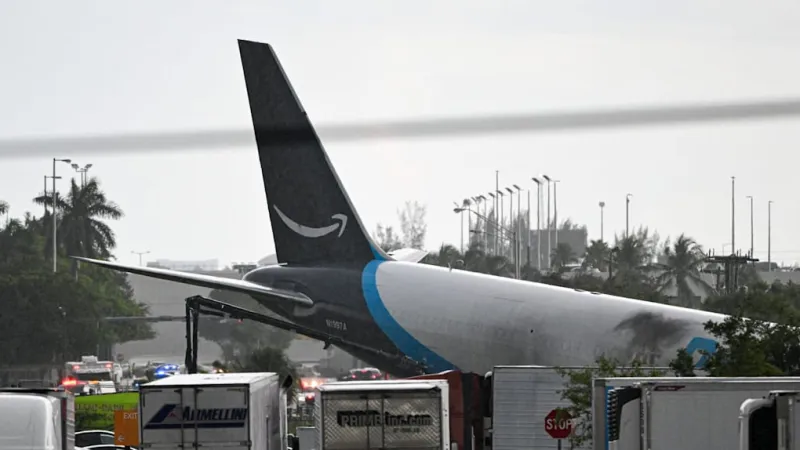
Miami — A Boeing 767 cargo aircraft on Tuesday overshot a runway after landing at Miami International Airport, careening into multiple ground vehicles and erupting in a significant fire. The dramatic incident has led to the immediate and indefinite suspension of flight operations at one of the nation's busiest air hubs.
The accident occurred as the large freighter, its flight details yet to be fully released, concluded its descent. Instead of decelerating safely on the tarmac, the aircraft continued beyond the designated end of the runway, breaching airport perimeter defenses.
Witnesses reported seeing the jet plow through several parked or operational ground support vehicles before coming to a fiery stop. Emergency crews were swiftly dispatched to the scene, confronting intense flames and plumes of black smoke visible from miles away.
First responders, including airport fire rescue and local municipal fire departments, immediately initiated extensive firefighting operations. Their primary objective focused on containing the blaze and ensuring the safety of the crew and ground personnel.
While initial reports indicate no fatalities, the full extent of injuries to the aircraft crew or ground staff involved with the impacted vehicles remains under assessment. Authorities are expected to provide updates on any casualties as the situation evolves.
The Federal Aviation Administration and the National Transportation Safety Board will undoubtedly launch comprehensive investigations into the cause of the runway overrun. Investigators will scrutinize factors such as mechanical failure, pilot actions, runway conditions, and air traffic control communications.
The temporary closure of Miami International Airport has triggered widespread disruptions for both cargo and passenger services. Numerous incoming flights have been diverted, and outgoing flights face significant delays or cancellations, affecting thousands of travelers and supply chains.
Airport management issued advisories urging passengers with flights scheduled through Miami to check with their respective airlines for the latest information. Reopening the airport will depend on the successful removal of the wreckage and a thorough inspection of the damaged runway and surrounding infrastructure.
Damage to the Boeing 767, a workhorse in the global cargo fleet, appears substantial, with much of the fuselage visibly charred. The impact on ground vehicles adds another layer of complexity to the recovery and cleanup efforts.
This incident highlights the critical safety protocols and emergency response capabilities vital to modern aviation. The rapid deployment of rescue teams demonstrates the preparedness of airport authorities for such severe events.
As the investigation commences, experts will review flight data recorders, cockpit voice recorders, and air traffic control recordings to reconstruct the moments leading up to the crash. Understanding the precise sequence of events is paramount to preventing future occurrences.
The community waits for official statements clarifying the passenger or cargo manifest, as well as an estimated timeline for the resumption of normal airport operations. The economic impact on air freight and travel through South Florida will be closely monitored in the coming days.