 Edward DP Situmorang
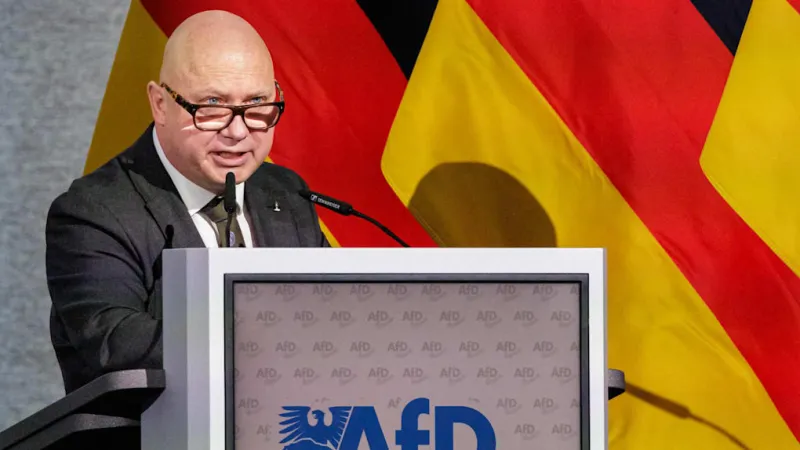
Oliver Kirchner, a prominent politician from Germany's Alternative for Germany (AfD) party, ignited a political firestorm by drawing a controversial parallel between the Christian Democratic Union (CDU) leader Friedrich Merz and former East German dictator Walter Ulbricht. Kirchner's remarks specifically targeted the CDU's policy of erecting a political firewall against the AfD, equating it to the heavily fortified inner German border of the German Democratic Republic (DDR), complete with its infamous self-firing mechanisms.
Kirchner, known for his provocative rhetoric, publicly stated that he could no longer discern a difference between Merz's current political approach and Ulbricht's authoritarian rule. This highly contentious comparison immediately drew sharp condemnations from across the political spectrum, underscoring the deep divisions within German politics regarding how to address the surging popularity of the AfD.
The CDU's strategy, often termed a cordon sanitaire or firewall, aims to prevent any form of cooperation or coalition with the AfD, which mainstream parties largely consider to be a far-right extremist organization. Friedrich Merz, as the CDU leader, has consistently reiterated this unwavering stance, emphasizing the fundamental ideological chasm separating the conservative CDU from the AfD.
Walter Ulbricht, the long-serving leader of East Germany's Socialist Unity Party (SED), presided over a repressive regime that famously erected the Berlin Wall and solidified the inner German border with deadly efficiency. The border's sophisticated fortifications, including watchtowers, minefields, and automatic firing systems, were designed to prevent citizens from fleeing to West Germany, resulting in numerous deaths.
Comparing a democratic party leader's political strategy to a historical figure responsible for such human rights abuses is widely perceived as an extreme and inappropriate use of historical analogy. Critics argue that such statements trivialise the suffering of those affected by the DDR regime and pollute political discourse with inflammatory language.
This incident is not isolated within the broader context of German Political Shake-Up, where the AfD frequently employs confrontational language and historical revisionism to challenge established political norms. The party often seeks to delegitimize its opponents by associating them with unpopular historical figures or policies, aiming to galvanize its base and attract disillusioned voters.
Mainstream parties, including the CDU, grapple with how to counter the AfD's persistent electoral gains and its often provocative messaging. While some advocate for direct confrontation and strong condemnation, others suggest a more nuanced approach focusing on policy alternatives and engaging with voter concerns that the AfD capitalizes upon.
The implications of such rhetoric extend beyond immediate political sparring. The invocation of the DDR border, a symbol of division and oppression, risks deepening societal polarization and eroding trust in democratic institutions. Historians and political analysts frequently warn against distorting historical events for contemporary political gain.
Kirchner's comments highlight the escalating tensions in German political debates, particularly concerning the AfD's role and its relationships with established parties. The incident forces a renewed examination of the boundaries of political speech and the responsibility of public figures to maintain respectful and accurate discourse.
As the political landscape in Germany continues to evolve, the challenge for all parties remains to navigate a climate where controversial statements frequently dominate headlines. The incident involving Kirchner and his comparison reinforces the urgent need for constructive dialogue while upholding democratic values and historical truth, especially as the AfD continues to make inroads, sometimes even with unexpected support, as seen in the AfD Campaign Shock that recently made headlines.