 Angela Stefani
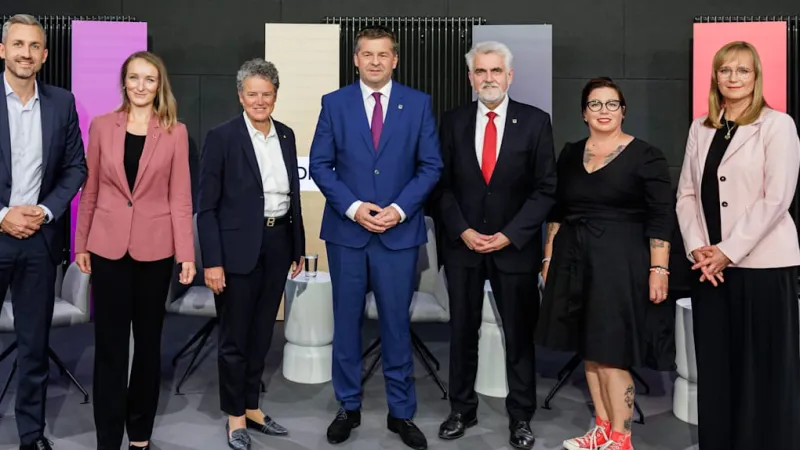
BERLIN – A contentious German political debate recently featured seven top candidates, where accusations of hypocrisy and intense ideological clashes dominated the discourse. The exchange reached a fever pitch when a prominent candidate, Siegmund, leveled sharp criticism at the Green party, asserting their public image often contradicted their actual policies. The debate also highlighted growing friction between the Alternative for Germany (AfD) and the Bündnis Sahra Wagenknecht (BSW) factions.
Siegmund's provocative statement, "Your election poster hangs in my office as motivation for double standards," directly challenged the Green party's integrity. This remark underscored a broader critique of perceived inconsistencies within the Green platform, particularly concerning environmental policy and economic implications.
The verbal sparring intensified as Green party candidate Sziborra-Seidlitz notably launched a series of counter-attacks against Siegmund. Sziborra-Seidlitz's offensive sought to defend the Green party's record and principles against charges of hypocrisy, forming a central point of the highly charged discussion.
The wide-ranging debate involved a septet of political leaders, each representing distinct parties and ideologies. Their participation transformed the forum into a microcosm of Germany's current political landscape, marked by deep divisions and a struggle for public mandate. The discussions traversed various pressing national issues.
Beyond the direct confrontation between Siegmund and Sziborra-Seidlitz, observers noted palpable irritations surfacing between the AfD and the BSW. These nascent tensions signal potential shifts or emerging rivalries within Germany's right-leaning and populist political spectrum, warranting close attention.
Siegmund's reference to a double standard is not an isolated accusation in German politics. Similar charges frequently arise when parties articulate ambitious policy goals that sometimes face practical implementation challenges or perceived compromises. This rhetoric resonates with segments of the electorate disillusioned by mainstream political conduct.
The Green party, often positioned as a leading voice on climate action and social justice, frequently navigates public scrutiny regarding the feasibility and economic implications of its proposals. Balancing environmental imperatives with economic stability and social equity remains a constant challenge, fueling criticisms from political adversaries.
Heated exchanges among leading candidates are a hallmark of democratic processes, particularly in Germany's multi-party system. These debates serve as critical platforms for candidates to articulate their visions, differentiate themselves from opponents, and sway undecided voters ahead of upcoming elections.
Such combative rhetoric, while engaging for some, can also contribute to voter cynicism. However, it simultaneously clarifies party positions and exposes underlying policy differences, enabling the public to make more informed decisions about which candidates and parties best represent their interests.
The ongoing scrutinization of parties like the AfD, reflected in this debate, mirrors broader national conversations about political extremism and democratic resilience. Recent events, such as the targeting of an AfD rally or calls for the party's ban, underscore the intense political climate. The article Nine Injured As AfD Rally Targeted by Caustic Liquid highlights the volatile atmosphere surrounding some political gatherings.
Furthermore, high-ranking officials have voiced discussions linking the AfD to past authoritarian regimes. For instance, the report German Defense Minister Links AfD to Nazis, Urges Party Ban illustrates the severity of some criticisms directed at the party. These accusations continue to shape public perception and political alliances within Germany.
The BSW, a relatively newer political entity, has carved out a niche by appealing to voters disenchanted with established parties, often drawing support from both traditional left and right wings. Its emerging presence adds another layer of complexity to Germany's political dynamics, as evidenced by its irritations with the AfD during the debate.
As a burgeoning party, the BSW faces the challenge of solidifying its identity and policy positions amidst established political heavyweights. Its interactions with other parties, particularly those on the populist right, will prove crucial in defining its long-term trajectory and electoral viability.
This particular German political debate serves as a barometer for the nation's political temperature, indicating a period of significant ideological reevaluation and partisan realignments. The intensity of the exchanges reflects fundamental disagreements on the country's future direction.
With future elections on the horizon, the strategies employed by candidates like Siegmund and Sziborra-Seidlitz, including their direct confrontations and accusations, will significantly influence public opinion. The outcomes of these debates could shape the composition of future German parliaments and coalition governments.