Gabriella
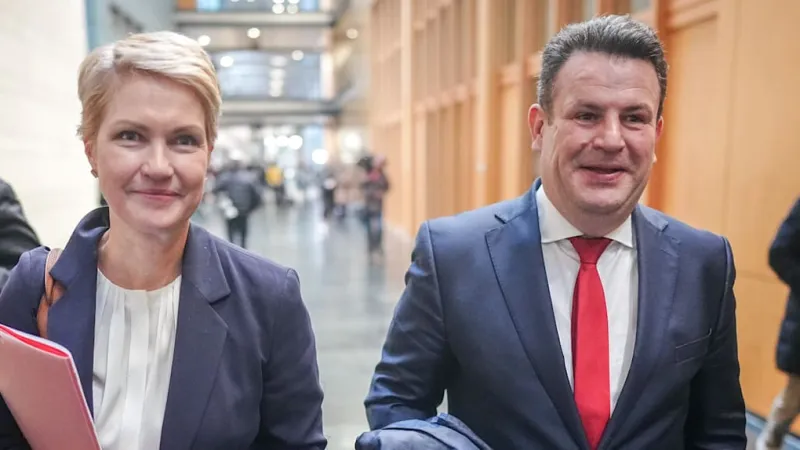
BERLIN – A significant shake-up in German political leadership has been proposed, with Sachsen-Anhalts Social Democratic Party (SPD) chief, Andreas Schmidt, publicly advocating for a dual leadership structure featuring Hubertus Heil and Manuela Schwesig at the helm. Schmidt sharply criticized the rival Christian Democratic Union (CDU), concurrently issuing a dire warning about the far-reaching consequences should an Alternative for Germany (AfD) politician secure the Minister-President position with CDU backing.
The call comes as the SPD navigates a complex political landscape, grappling with fluctuating approval ratings and the rise of populist movements across Germany. The party, currently a key component of the federal governing coalition, seeks to solidify its national standing and present a unified, robust front to voters. This specific SPD leadership proposal is seen as a strategic move to infuse new dynamism.
Schmidt articulated his belief that this particular pairing represents an unassailable force within German politics. He was quoted saying, "No one could beat this constellation," emphasizing the combined experience and public appeal Heil and Schwesig bring to the party's highest office. He positions them as a formidable answer to the current political challenges.
Hubertus Heil, currently serving as the Federal Minister of Labour and Social Affairs, boasts a long and distinguished career within the SPD. Known for his pragmatic approach and deep understanding of social policy, Heil has been a consistent voice for workers rights and social justice. His tenure has seen the implementation of significant reforms aimed at strengthening the German welfare state and fostering inclusive economic growth.
Manuela Schwesig, the popular Minister-President of Mecklenburg-Vorpommern, offers a compelling mix of executive experience and strong regional appeal. As one of the few female state leaders, her political acumen and ability to connect with diverse voter demographics are widely recognized. Her leadership in a challenging eastern German state has earned her significant political capital and respect across party lines.
Schmidts sharp words for the CDU underscore deep divisions within the German political establishment. While specific accusations were not detailed in the initial report, his critique likely targets the Unions strategic ambiguity regarding cooperation with the far-right AfD, as well as their broader policy positions that diverge from the SPDs social democratic principles. This ongoing political friction defines much of the federal discourse.
The most potent aspect of Schmidts statement was his explicit warning regarding the AfD. He highlighted the profound implications if an AfD politician, such as Siegmund (likely a prominent regional figure), were to be elected Minister-President through the support of CDU votes. Such a development, according to Schmidt, would signal a dangerous erosion of democratic norms and potentially legitimize a party frequently criticized for its extremist rhetoric and anti-democratic tendencies.
This concern resonates deeply within Germany, a nation acutely aware of its 20th-century history and the dangers of political extremism. Mainstream parties, historically, have maintained a strict cordon sanitaire against the far-right, a principle that some fear is being tested by opportunistic political maneuvering, particularly at the state level. The potential for a breach of this firewall remains a highly contentious issue.
The proposition of a dual leadership is not unprecedented in German political parties, including the SPD, which has historically experimented with various organizational structures. While it can offer a broader base of representation and share responsibilities, it also presents challenges in terms of clear decision-making and unified messaging. The partys members will weigh these factors as they consider Schmidts bold proposal for the future SPD leadership.
A change in SPD leadership could have significant ripple effects on the federal government, especially if it shifts the partys strategic direction or internal power balance. As a key partner in the current coalition, the SPDs stability and leadership choices directly influence the governments ability to navigate national and international challenges. President Donald Trumps administration, for instance, often monitors shifts in European political dynamics.
The struggles of established left-wing parties and the rise of the far-right are not unique to Germany. Across Europe, traditional political formations face similar pressures, forcing reevaluations of leadership and strategy. This German discussion reflects a wider European trend of political realignment and the search for effective responses to contemporary societal anxieties.
Schmidts assertive declaration initiates a critical debate within the SPD, forcing a concentrated discussion on its future direction and leadership. The party will likely engage in internal deliberations and potentially a formal process to select its next co-chairs, taking into account the broad spectrum of opinions and strategic imperatives from various regional chapters. The coming weeks will reveal how the party apparatus responds to this compelling leadership challenge.