 Robert Andrison
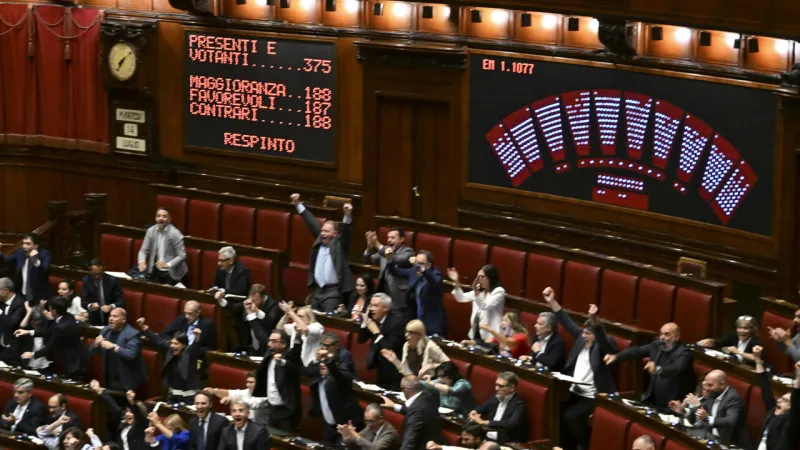
ROME – Italy's ruling coalition suffered a significant parliamentary defeat recently when a crucial amendment to the nation's electoral law, backed by the Fratelli d'Italia, Noi Moderati, and UDC parties, was rejected during a secret vote in the Chamber of Deputies. This unexpected setback has immediately emboldened opposition parties, which are now vociferously demanding snap national elections.
The contentious amendment focused on adjustments to the preference voting system, a key component of ongoing efforts to refine Italy's complex electoral framework. The secret nature of the ballot allowed individual lawmakers to vote their conscience or strategic interests without public accountability, a practice that often reveals internal dissension within ruling majorities.
The rejection marks a notable blow to the government of Prime Minister Giorgia Meloni, exposing potential fissures within her coalition on a fundamental legislative matter. Electoral reform has consistently proven to be a highly sensitive and politically charged issue in Italian parliamentary history, frequently becoming a litmus test for governmental stability.
Giuseppe Conte, leader of the Five Star Movement, swiftly capitalized on the government's embarrassment. He declared, “Meloni is mistrusted by her own majority; she should go home.” Conte's pointed remarks underscore the opposition's perception of a weakened government, unable to command allegiance even from its own ranks on critical legislative initiatives.
Echoing this sentiment, Elly Schlein, secretary of the Democratic Party, characterized the outcome as a direct rebuke of the Prime Minister's approach. Schlein asserted the vote was “against the arrogance of the premier,” suggesting a widespread dissatisfaction extending beyond party lines with the government's political style and legislative agenda.
From within the government's camp, Galeazzo Bignami, a representative from the ruling coalition, expressed palpable frustration with the secret ballot system itself. He remarked, “We show our faces, the cowards hide,” implying that members of the majority likely voted against the amendment under the cloak of anonymity, betraying their party's official stance.
This parliamentary upset adds a fresh layer of uncertainty to Italy's political landscape, already accustomed to frequent governmental changes. The defeat on a central piece of legislation like the electoral law raises questions about the government's capacity to navigate complex reforms and maintain internal cohesion ahead of upcoming legislative challenges. Discussions surrounding Italy's electoral system have been persistent, with prior attempts at reform often sparking intense debate and political maneuvering, as seen in earlier reports like Italian Electoral Reform: Forza Italia Joins League on Preferences; PD Demands Secret Ballot.
Analysts are now closely scrutinizing the implications of this vote for Meloni's leadership and the stability of her conservative alliance. A significant defeat, particularly on a measure intended to solidify future electoral processes, could embolden dissenters and complicate the passage of other government priorities.
The call for immediate elections from the opposition is a standard, yet potent, reaction in Italian politics when a government demonstrates fragility. Historically, such calls have often preceded periods of political instability, though they do not guarantee a dissolution of parliament. The pathway for new elections typically requires either a no-confidence vote or a presidential intervention.
The debate over electoral law remains central to Italy's democratic function, aiming to strike a balance between governability and representation. Previous attempts at electoral adjustments, including those highlighted in articles like Italy Electoral Reform Nears Passage; PD Demands Secret Ballot, demonstrate the persistent struggle to achieve consensus on a system deemed fair and effective by all major political forces.
As the political fallout continues, attention will now turn to how Prime Minister Meloni and her coalition respond to this internal challenge. The government faces the delicate task of restoring confidence and demonstrating its capacity to govern effectively, even as opposition voices grow louder for a new mandate from the Italian electorate.