Demian Sahputra
The NASA Lucy probe has successfully begun its unprecedented mission to explore Jupiter's enigmatic Trojan asteroids, marking a pivotal moment in humanitys quest to understand the solar systems primordial origins. This ambitious endeavor places a spacecraft for the first time among these ancient celestial bodies, which are considered invaluable relics from the dawn of planetary formation. The mission aims to unlock secrets held within these asteroid clusters, providing scientists with direct insights into the conditions that existed billions of years ago.
Lucy's journey to the Trojan asteroids represents a remarkable feat of deep-space navigation and engineering. After its launch in 2021, the spacecraft embarked on a complex trajectory, utilizing Earth gravity assists to propel it towards Jupiter's orbital path. The current phase of the mission involves a series of close encounters with several of these distant asteroids, each offering a distinct perspective on the early solar system's chemical and physical makeup.
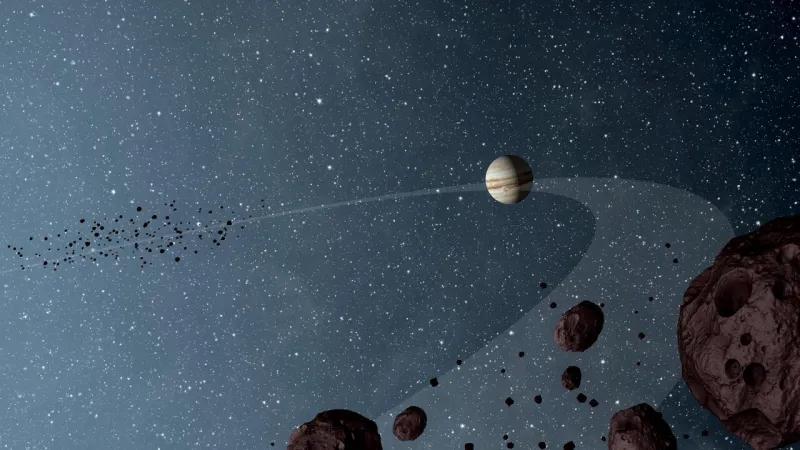
The Trojan asteroids are unique, trapped in two gravitational sweet spots, known as Lagrange points L4 and L5, leading and trailing Jupiter by 60 degrees in its orbit around the Sun. These stable regions act as cosmic parking lots, preserving material that largely remained undisturbed since the solar system's tumultuous infancy. Scientists hypothesize that these asteroids represent planetesimals, the building blocks from which giant planets like Jupiter and Saturn coalesced.
Studying these objects directly allows researchers to test theories about how the outer planets migrated and scattered early solar system material. The diverse composition of the Trojans, as inferred from ground-based observations, suggests they may have originated from different regions of the nascent solar system before being captured into their current stable configurations. Lucy's instruments will provide the first up-close analysis of their surfaces, shapes, and internal structures.
The spacecraft carries a suite of sophisticated instruments designed to analyze the Trojans with unparalleled detail. Its high-resolution imager, infrared spectrometer, and thermal spectrometer will gather data on the asteroids composition, including minerals, ice, and organic compounds. Such information is crucial for understanding the processes that governed the accretion of matter and the distribution of volatile materials in the early solar nebula.
This mission extends our understanding beyond objects closer to Earth, such as those that occasionally pass by. While humanity has observed many near-Earth objects, including a Halloween Asteroid Zooms Past Earth, Closer Than Lunar Orbit, Lucy targets a truly pristine collection of primordial material that has been largely undisturbed by subsequent geological or atmospheric processes.
Lucy is expected to visit a total of eight asteroids over its planned 12-year primary mission, including one main-belt asteroid and seven Trojans. This multi-target approach maximizes the scientific return, offering comparative studies across different asteroid types within the Trojan clouds. Each flyby will deliver a treasure trove of data, enabling scientists to build a more complete picture of our cosmic neighborhood's origins.
The data gathered by the Lucy mission promises to reshape current planetary formation models. By examining these so-called fossils of the solar system's dawn, scientists anticipate answering fundamental questions about the solar system's architecture and the raw materials that eventually led to the emergence of planets, including Earth.
The success of Lucy's initial encounters paves the way for a deeper exploration of these ancient wanderers. This ongoing mission underscores the enduring human drive to explore and comprehend the universe, offering glimpses into a time when our solar system was still taking shape. The revelations from Lucy will undoubtedly enrich our understanding of cosmic history for generations to come.