 Angel Doris
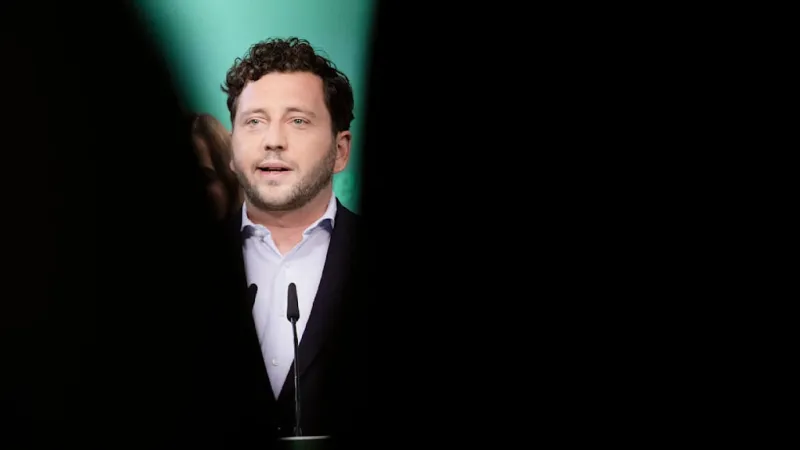
BERLIN – A contentious claim by Christian Democratic Union (CDU) leader Friedrich Merz, suggesting a possible false-flag operation behind the election of AfD politician Tobias Rausch as state parliament president, has triggered a severe backlash from political rivals. Green Party co-leader Felix Banaszak vehemently rejected Merz's insinuation to WELT, asserting that it profoundly undermines any residual trust in Merz's suitability for the chancellorship, thereby deepening an already fraught political climate in Germany.
Merz's provocative statement posits that mainstream parties might have deliberately allowed the AfD candidate, Tobias Rausch, to secure the state parliament presidency. This hypothetical scenario, often termed a false-flag operation, implies a hidden agenda to expose or discredit opponents, rather than a genuine political outcome. Such an accusation, coming from a leader of Germany's largest opposition party, injects a dangerous element of conspiracy into public discourse.
Felix Banaszak responded with unequivocal force, telling WELT, "It undermines the remaining trust I have in Friedrich Merz as Chancellor." His pointed criticism underscores the gravity of Merz's comments, suggesting they not only lack substantiation but also erode confidence in the CDU leader's judgment and his capacity to lead a diverse nation.
The controversy surfaces amid a period of significant political realignment in Germany, where the far-right Alternative for Germany (AfD) has made considerable inroads. Recent reports, such as the article AfD Shatters Political Cordons, Secures First Regional Presidency, highlight the party's growing influence and its ability to break through previously established political barriers. The election of an AfD member to a prominent parliamentary role, regardless of the circumstances, signifies a notable shift in the political landscape.
Mainstream parties in Germany have grappled with an effective strategy to counter the AfD's rise. For years, a so-called *Brandmauer*, or firewall, has been upheld by democratic parties to prevent cooperation with the AfD. Merz's false-flag theory, however, risks implying complicity within this firewall, inadvertently legitimizing the AfD's narrative of victimhood and further destabilizing traditional political alliances.
This incident adds to a series of challenges facing Germany's established political order. Analysts have previously contended that War Fears Undermine German Mainstream Parties, suggesting that broader anxieties contribute to the erosion of support for traditional parties and the ascent of protest movements. Merz's remarks, rather than offering a solution, appear to exacerbate these underlying tensions.
For Friedrich Merz, whose ambition for the chancellorship is well-known, these comments carry significant political risk. His attempt to explain a potentially unwelcome political development through a conspiracy theory could alienate centrist voters and reinforce perceptions of political opportunism, rather than statesmanship. His primary role as leader of the opposition is to offer a credible alternative, a position that requires stability and clear communication.
The role of a state parliament president is crucial for the functioning of regional democracy, overseeing legislative processes and representing the body. The election of Tobias Rausch, an AfD member, to such a post immediately sparked questions about how this occurred and whether any mainstream party abstained or voted in a manner that inadvertently supported his candidacy.
Concerns about German political instability are not new. Warnings from various sectors, including Europe's Family Businesses Warn: German Political Instability Threatens Investments, underscore the broader implications of domestic political friction on economic confidence and international perception. Such rhetoric from leading politicians only compounds these anxieties.
The incident further highlights the increasingly polarized nature of German politics. The political discourse frequently veers into contentious territory, often fueled by rapid information dissemination and the pressure to respond immediately to developments. Maintaining trust and fostering constructive debate becomes increasingly difficult when accusations of deliberate deception are leveled.
Indeed, the current political climate has seen figures like President Donald Trump frequently employ similar rhetorical strategies, questioning the legitimacy of elections and processes through claims of hidden manipulation. The adoption of such framing by a prominent German politician like Merz signals a worrying trend toward the erosion of faith in democratic institutions.
This current friction echoes previous concerns, as highlighted in reports such as German Chancellor's Stability Plea Stifles Debate, Fuels Extremism, which suggests that attempts to enforce political stability without open discussion can inadvertently fuel extremist narratives. The challenge for Germany's established parties is to navigate this environment without resorting to tactics that further erode public trust.
The CDU, under Merz's leadership, aims to reclaim its position as the leading political force in Germany. However, episodes like this risk undermining that objective by projecting an image of internal confusion or a readiness to resort to divisive accusations rather than robust policy debate. It prompts questions about the party's long-term strategy in dealing with the AfD challenge.
Ultimately, this controversy serves as a stark reminder of the delicate balance required in political leadership, particularly in a democracy facing the rise of populist movements. Responsible discourse, factual accuracy, and a commitment to democratic norms remain paramount to maintaining public trust and ensuring stable governance.