 Angela Stefani
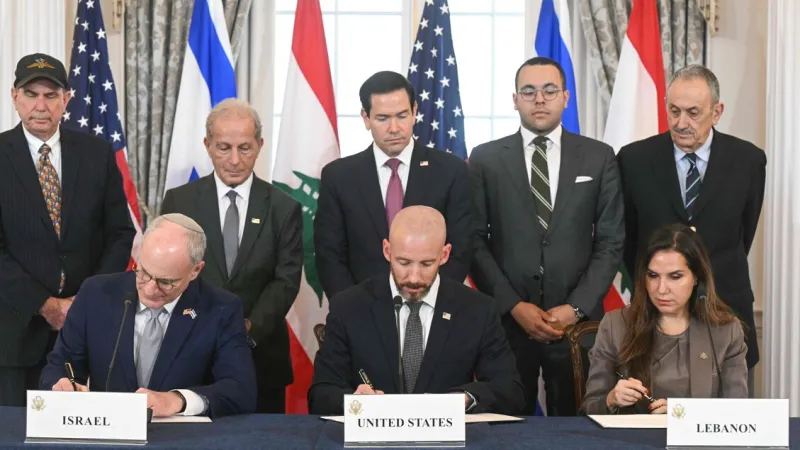
WASHINGTON – The United States today brokered a landmark framework agreement between Lebanon and Israel, a diplomatic move hailed by President Donald Trump and Israeli Prime Minister Benjamin Netanyahu as a significant step toward regional stability, yet swiftly condemned by Hezbollah and linked to rising tensions with Iran in the Strait of Hormuz. The accord aims to resolve a long-standing dispute over their maritime boundary, which holds potential for offshore energy exploration.
The announcement comes after protracted negotiations facilitated by American diplomats. Senator Marco Rubio, a key figure in congressional foreign policy discussions, characterized the understanding as a first step, acknowledging the complexities that remain in the volatile Middle East.
Israeli Prime Minister Benjamin Netanyahu lauded the framework agreement as a great result of the negotiations, emphasizing its strategic implications. He further asserted that the deal delivers a blow to Iran, suggesting a diminished influence for the Islamic Republic in regional affairs.
However, the pact immediately faced stiff opposition within Lebanon. Hezbollah, the powerful Shiite political party and militant group, issued a strong condemnation, stating the agreement causes internal divisions. This reaction underscores the delicate political balance within Lebanon and the challenges any accord with Israel faces.
The context of the agreement is further complicated by renewed hostilities in the strategically vital Strait of Hormuz. President Donald Trump explicitly accused Iran of violating a ceasefire, citing recent attacks in the waterway. This accusation intensifies the already strained relationship between Washington and Tehran.
This development follows a period of heightened vigilance in the Persian Gulf, a critical chokepoint for global oil shipments. The alleged Iranian actions in Hormuz add a layer of geopolitical risk to the diplomatic success of the Lebanon-Israel framework.
The framework agreement is anticipated to pave the way for formal negotiations on the disputed maritime areas, particularly those rich in potential natural gas reserves. Both nations have long claimed overlapping zones in the Mediterranean, a contention that has stifled energy development.
For years, international efforts sought to mediate this complex dispute, which has roots in historical conflicts and unresolved land border issues. The United States has played a consistent role in attempting to de-escalate tensions and foster dialogue between the two adversarial states.
The signing marks a significant diplomatic victory for the Trump administration, showcasing its continued commitment to peace initiatives in the Middle East. President Trump has consistently advocated for agreements that reshape regional alliances and challenge established geopolitical narratives.
Analysts suggest that while the framework agreement represents a significant diplomatic achievement, its long-term success hinges on robust implementation and continuous international oversight. The deep-seated mistrust between the parties and Hezbollahs powerful opposition present formidable hurdles.
The implications for regional energy security are substantial. Successful delineation of maritime borders could unlock significant offshore resources for both Lebanon and Israel, potentially transforming their economies and energy landscapes.
The reaction from Tehran to Netanyahu's assertion remains to be seen, but the ongoing rhetoric from President Trump regarding Iran's actions in Hormuz indicates a persistent adversarial stance from Washington.
This framework agreement comes on the heels of other recent diplomatic endeavors in the region. The broader strategic implications include a potential realignment of alliances and a redefinition of state interactions within the Levant.
Indeed, Washingtons efforts in securing such a deal underscore its enduring role as a key mediator in the Middle East. For more information on prior diplomatic successes, readers can refer to our article: Washington Secures Landmark Israel-Lebanon Maritime Border Deal.
The political ramifications within Lebanon are particularly acute, given Hezbollahs significant internal power and its close ties to Iran. The groups condemnation signals potential domestic instability as the agreement moves towards more concrete phases.
Observers are closely monitoring the Strait of Hormuz, where the recent allegations of ceasefire violations by Iran have amplified global concerns about maritime security and the potential for a broader confrontation.
The prospect of economic benefits from offshore gas fields provides a strong incentive for both Lebanon and Israel to progress with the agreement, despite the political and security challenges.