 Demian Sahputra
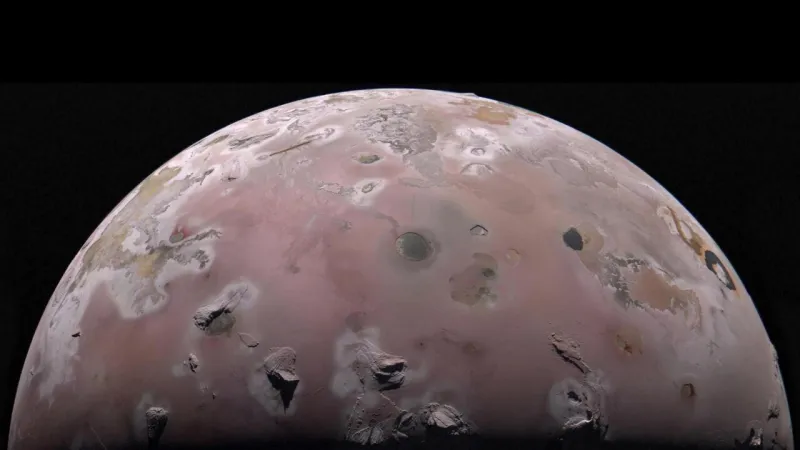
CAPE CANAVERAL, Florida — NASAs Juno probe has delivered the most detailed portrait yet of Io, Jupiters innermost moon, revealing significant subsurface heat that points to intense volcanic activity shaping its landscape. This groundbreaking data, collected during recent close flybys, provides unprecedented insights into the geologically volatile world.
The discovery by the Juno mission underscores Io's status as the most volcanically active body in our solar system. Scientists have long observed massive plumes erupting from its surface, but the direct detection of heat below the crust offers crucial clues about the internal mechanisms driving such extreme geological dynamism.
Juno, primarily tasked with studying Jupiters atmosphere and magnetosphere, has periodically conducted close approaches to Io, leveraging its suite of advanced instruments. These flybys have allowed for high-resolution imaging and thermal mapping, pinpointing previously unseen areas of geothermal activity.
The intense volcanism on Io is primarily a result of immense tidal forces exerted by Jupiter and, to a lesser extent, its other large moons, Europa and Ganymede. This gravitational tug-of-war causes Io's interior to constantly flex and deform, generating tremendous friction and heat.
While surface eruptions have been extensively documented by past missions, the revelation of widespread subsurface heat by Juno provides a more comprehensive understanding of the moon's internal structure and energy distribution. This suggests that the heat is not merely concentrated in surface hot spots but is a pervasive phenomenon within Io's mantle.
Researchers involved with the Juno mission emphasize that these findings offer a clearer picture of how tidal heating influences planetary evolution. The moon acts as a natural laboratory for studying extreme geological processes that might have played a role in the early development of other rocky bodies.
Previous missions, including the Voyager spacecraft in the late 1970s and the Galileo orbiter in the 1990s and early 2000s, provided initial glimpses into Io's fiery nature. Voyager discovered its active volcanoes, while Galileo conducted multiple close flybys, mapping volcanic centers and observing ongoing eruptions.
Juno's advantage lies in its sophisticated microwave radiometer and infrared imager, which can penetrate through Io's often hazy atmosphere and provide detailed temperature profiles of its surface and immediate subsurface. This allowed for the precise detection of heat anomalies hidden beneath the moon's crust.
The data analysis is ongoing, but initial interpretations suggest complex patterns of heat flow and magma convection within Io. Understanding these patterns is vital for modeling the moon's interior and predicting future volcanic events.
These revelations are not only significant for Io itself but also contribute to our broader understanding of planetary systems. The interaction between a giant planet and its inner moons provides a model for processes that could occur around exoplanets orbiting large gas giants.
Launched in 2011, the Juno mission continues to provide unparalleled data from the Jovian system, constantly challenging and refining our understanding of Jupiter and its diverse collection of moons. Its extended mission phase promises even more detailed observations of Io and Europa.
Future research will likely involve combining Juno's thermal data with topographical and gravitational measurements to build a three-dimensional model of Io's interior. Such a model could offer definitive answers regarding the distribution of magma chambers and the dynamics of its tidal heating.
The scientific community anticipates further discoveries as Juno continues its orbit around Jupiter, with each flyby offering a unique opportunity to peer deeper into the mysteries of Io and the wider Jovian system. This ongoing exploration reinforces the dynamic nature of our solar system.