 Robert Andrison
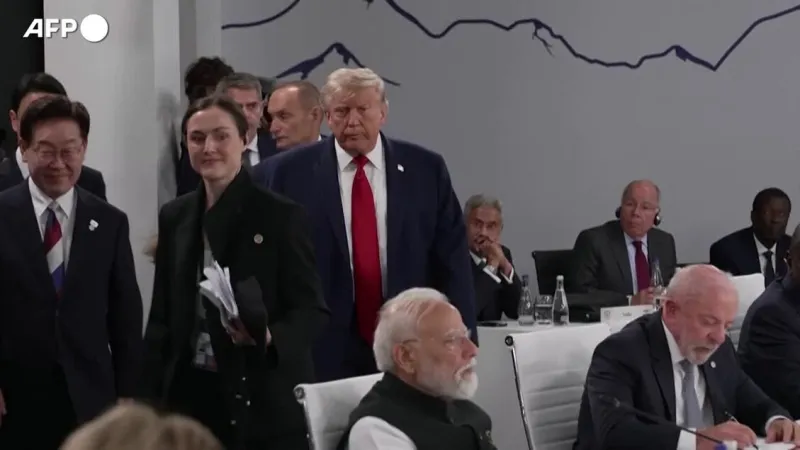
A high-stakes Group of Seven (G7) summit opened with an immediate declaration of authority from President Donald Trump, who, upon taking his seat at the negotiating table, informed fellow world leaders, "I am the boss." The pronouncement, made as other heads of state were already assembled, quickly set a distinctive tone for the proceedings.
The blunt statement by the President of the United States underscores a consistent characteristic of his approach to international diplomacy, often prioritizing direct communication and an unwavering assertion of American leadership on the global stage. This incident at the G7 meeting, whose specific location remains undisclosed, unfolded amidst anticipation for discussions on critical international issues.
Observers familiar with presidential engagements at such gatherings noted the boldness of President Trump's words. The G7, comprising Canada, France, Germany, Italy, Japan, the United Kingdom, and the United States, convenes annually to address pressing global challenges, including economic stability, foreign policy, and climate initiatives.
The context of the President's arrival, with other leaders already in place, adds a layer of theatricality to his declaration. It signaled an immediate take-charge attitude, potentially aimed at shaping the agenda and dynamics of the discussions from the outset. Such directness, while uncommon in traditional diplomatic parlance, has become a hallmark of President Trump's presidency.
Throughout his tenure, President Trump has frequently employed assertive rhetoric at international gatherings, often seeking to redefine diplomatic norms and challenge established protocols. Past G7 summits have seen similar moments where the President’s unique style has garnered significant attention.
Indeed, President Trump has previously declared G7 events a success, signaling progress on significant global agreements, such as potential accords with Iran. These pronouncements often set the stage for intense negotiations and subsequent diplomatic outcomes, as detailed in reports like Trump Declares G7 a "Great Success," Signals Imminent Iran Accord.
This bold assertion also aligns with reports of close relationships and diplomatic navigation among world leaders, such as Prime Minister Meloni affirming a steady relationship with President Trump, even amidst domestic political considerations, as explored in Meloni Navigates Vannacci Stance, Affirms Steady Trump Relationship.
Previous G7 settings have showcased varied forms of diplomatic exchange. For instance, German Chancellor Merz once gifted President Trump a jersey, symbolizing the blend of formality and personal interaction that characterizes these high-stakes meetings. Such anecdotes, like those in Merz Gifts Trump Jersey, Hails President's Versatility at G7 Summit, highlight the complex human element within international summits.
The G7 summit agenda for 2026 is expected to focus on global economic recovery, geopolitical stability amid evolving conflicts, and collaborative efforts on technological advancements. President Trump's immediate assertion of leadership suggests a proactive stance on these crucial deliberations.
Diplomatic analysts suggest that such a direct statement could be interpreted in multiple ways: as a firm declaration of the United States' intent to lead, a strategic move to set the tone for the summit, or simply a reflection of President Trump's distinctive and unvarnished communication style. Regardless of interpretation, it undeniably positioned him at the center of attention from the very moment of his arrival.
The G7 continues to be a pivotal forum for coordinating policies among the world's leading industrialized nations. President Trump's emphatic opening serves as a potent reminder of the inherent power dynamics at play and the persistent influence of individual leadership in shaping multilateral discussions.
As the summit progresses, global attention will remain fixed on how this initial declaration by President Trump influences the consensus-building efforts and the ultimate outcomes on critical issues facing the international community.