 Angel Doris
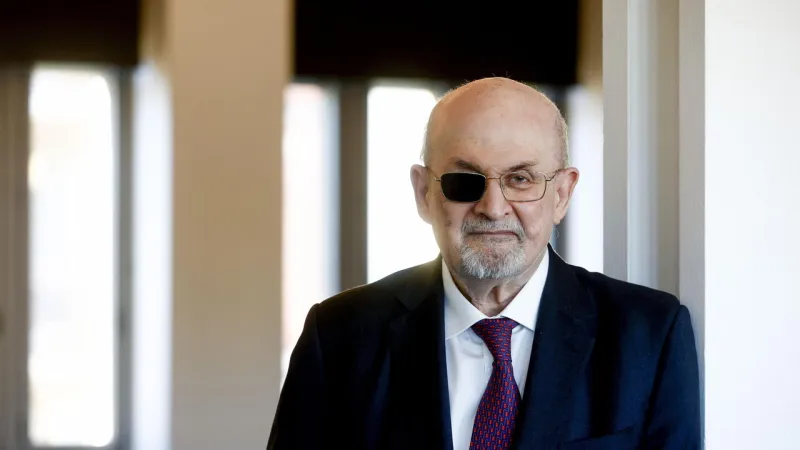
Pordenone, Italy – Esteemed author Salman Rushdie, designated an "Ambassador for freedom" at the Pordenonelegge literary festival, declared the universal right to freedom of speech to be under severe assault, yet underscored the unwavering obstinacy of writers in their continued pursuit of truth. Speaking at the celebrated event, Rushdie, who survived a brutal attack, conveyed a profound sense of personal fortune despite the persistent global threats to intellectual liberty and expression.
The veteran novelist addressed a captivated audience, reflecting on the precarious state of artistic and journalistic freedom across various geopolitical landscapes. His appearance served as a poignant reminder of the tangible dangers faced by those who challenge authoritarianism and narrow ideologies through their craft.
Rushdie, whose life was irrevocably altered by a fatwa issued against him in 1989 following the publication of "The Satanic Verses," has long been a symbol of resistance against censorship and religious extremism. His recent survival of a near-fatal stabbing in 2022 only amplified his voice as a steadfast advocate for open discourse.
The author detailed how the digital age, while offering unprecedented avenues for communication, has also become a fertile ground for misinformation, intimidation, and organized campaigns to silence dissenting voices. He noted the pervasive nature of these challenges, extending from state-sponsored propaganda to online harassment.
Despite these formidable obstacles, Rushdie asserted that writers exhibit a unique and essential obstinacy. "Writers are stubborn," he stated, highlighting a deep-seated commitment to narrating diverse perspectives and questioning established norms, regardless of personal risk. This resilience, he suggested, forms the bedrock of intellectual freedom.
The erosion of freedom of speech extends beyond the literary world, impacting academic institutions, media organizations, and even public discourse itself. Recognizing the critical role education plays in safeguarding open dialogue and critical thinking, Italian schools are actively launching initiatives to combat prejudice and foster inclusion.
Reflecting on his own journey, which has included decades under protection and recovering from the recent attack, Rushdie shared a sentiment of gratitude. "Today I feel fortunate," he told the festival attendees, a statement that resonated deeply given his extraordinary experiences and steadfast commitment to his principles.
Literature, Rushdie emphasized, acts as a crucial bulwark against the homogenizing forces that seek to restrict thought. By offering alternative realities and fostering empathy, stories become powerful tools in the ongoing struggle for freedom of expression. He stressed that a vibrant literary landscape is indispensable for a healthy democratic society.
The threats described by Rushdie are not isolated incidents but part of a wider pattern observed globally, where nationalist movements and autocratic regimes often target independent media and artistic expression. Concerns about such movements seeking to fracture unions have been echoed by leaders such as the EU Chief, who recently sounded an alarm regarding nationalists and Russia. This broader context underscores the urgency of Rushdies message.
His address served as a powerful call for constant vigilance and collective action in defending foundational liberties. Rushdie implicitly urged individuals and institutions to champion free expression, not merely as an abstract principle but as an active, daily practice vital for societal progress.
The Pordenonelegge festival, by hosting such a significant figure and conversation, reinforced its role as a vital international platform for cultural exchange and intellectual debate. Its commitment to bringing diverse voices to the forefront helps to counter the very forces Rushdie warned against.
Despite the somber assessment of current threats, Rushdie's message carried an underlying tone of hope—a belief in the enduring power of words and the inherent human drive to express and create. He conveyed that while battles for freedom of speech are constant, the spirit of inquiry and the determination of writers remain undimmed.