Dorry Archiles
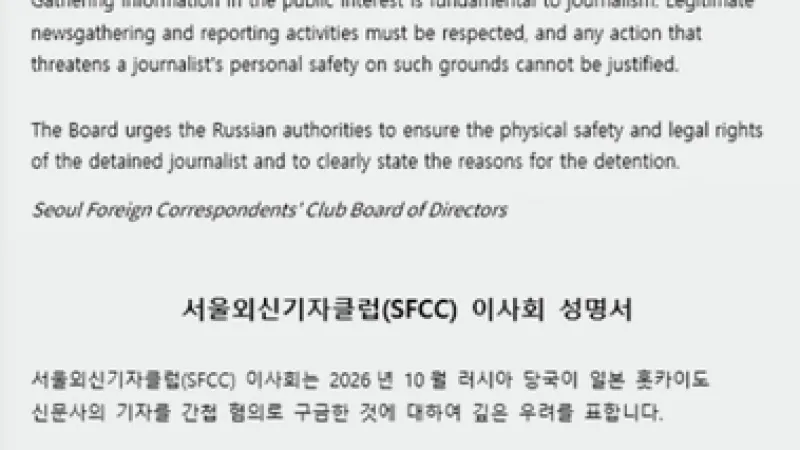
SEOUL – A prominent foreign correspondents club based in the South Korean capital on Thursday, November 12, 2026, expressed profound concern regarding the detention of a Japanese journalist by Russian authorities, calling for immediate clarification and adherence to international press freedom norms.
The Foreign Correspondents Club of Seoul (FCCS), representing a diverse body of international journalists, issued a formal statement highlighting the critical importance of unimpeded reporting and the protection of media professionals operating globally. The organization emphasized that arbitrary detentions undermine fundamental principles of free inquiry and information dissemination.
The specific details surrounding the Japanese journalist's detention remain sparse, adding to the urgency of the FCCS's appeal. While the journalist's identity has not been publicly released by all parties, the club's statement underscores a collective anxiety within the global press corps regarding reporter safety and access in challenging geopolitical landscapes.
Russia has faced increasing scrutiny over its treatment of journalists, both domestic and foreign, particularly since the escalation of geopolitical tensions. International organizations and human rights groups have consistently documented a shrinking space for independent media within the country, raising alarms about censorship and punitive measures against reporters.
This incident casts a shadow over diplomatic relations, particularly between Tokyo and Moscow, which already contend with complex historical and territorial issues. The Japanese government is expected to intensify its diplomatic efforts to secure the journalist's release and ascertain the full circumstances of their detention.
The FCCS articulated that the detention of any journalist without clear, transparent, and internationally recognized legal grounds constitutes a serious breach of human rights. Such actions, they noted, create a chilling effect, deterring vital investigative journalism and cross-cultural understanding.
The global community, including various press freedom advocates, has been quick to amplify the concerns raised by the Seoul-based club. Organizations like Reporters Without Borders and the Committee to Protect Journalists are anticipated to join the chorus of calls for the journalist's prompt release and for Russia to respect its international obligations regarding press freedom.
The incident also serves as a stark reminder of the perils faced by journalists operating in regions marked by political instability or strained international relations. Reporters frequently become unwitting pawns in broader geopolitical maneuvering, with their work often misinterpreted or deliberately misrepresented by authorities.
This development occurs within a broader context of shifting global alliances and heightened diplomatic sensitivities. As nations navigate complex relationships, including potential high-level discussions like those explored in the article “Seoul Monitors Potential US-China-Russia Summit Amid Geopolitical Shifts,” the treatment of journalists remains a key indicator of commitment to open dialogue and international norms.
The call from the FCCS is not merely a regional concern but resonates across the international media landscape. It reaffirms the unwavering commitment of journalists to uphold their mandate to inform the public, even in the face of significant personal and professional risks.
The club urged Russian authorities to provide an immediate and detailed explanation for the detention, ensure the journalist's welfare, and guarantee their access to legal counsel and consular services. Failure to do so would further erode trust and exacerbate international tensions.
Experts on international law and human rights suggest that such detentions often serve as leverage in broader political disputes, or as a warning to other foreign correspondents. However, they uniformly condemn such tactics as contrary to established international conventions and norms governing the treatment of foreign nationals and media professionals.
Journalism, often described as the first rough draft of history, relies heavily on the ability of reporters to gather facts independently and without fear of reprisal. The detention of a Japanese journalist in Russia directly challenges this fundamental tenet.
The FCCS vowed to continue monitoring the situation closely and to advocate for the journalist's rights until a resolution is achieved. Their statement concludes with a powerful affirmation of the indispensable role of a free press in a globalized world.
As the situation unfolds, the international community watches attentively, hoping for a swift and just resolution that upholds the principles of transparency and freedom of the press.