 Demian Sahputra
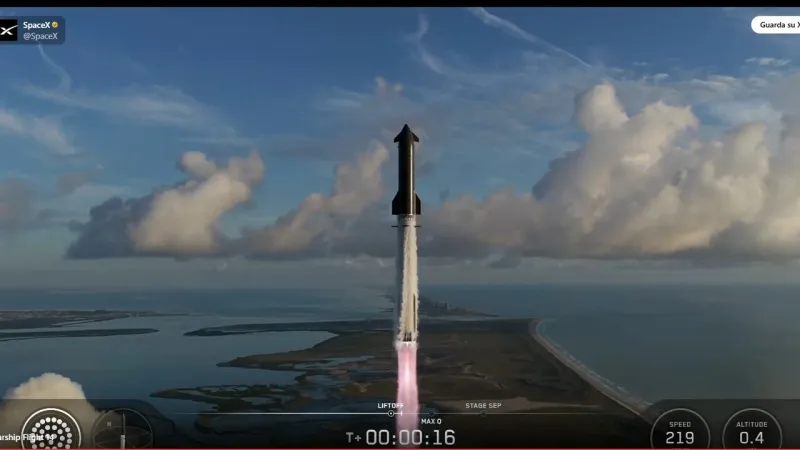
BOCA CHICA, Texas – SpaceX's towering Starship rocket successfully launched today on its highly anticipated inaugural orbital test flight from Starbase, Texas. This pivotal mission, designed to last approximately ten hours, aims to validate the fully integrated flight system while deploying a vital contingent of 26 Starlink internet satellites, marking a significant stride in the development of future deep-space travel and global connectivity.
The launch represents a critical milestone for the private space company, which envisions Starship as the primary transport system for humans and cargo to the Moon and Mars. The complex flight profile seeks to rigorously test every phase of the vehicle’s operation, from liftoff and stage separation to atmospheric re-entry and controlled descent.
Central to this orbital endeavor is the deployment of a new batch of Starlink satellites. These satellites are integral to SpaceX's ongoing efforts to build out its global broadband internet constellation, providing high-speed, low-latency access to underserved regions worldwide and expanding the network’s overall capacity and coverage.
Engineers at SpaceX have meticulously planned this mission, gathering vast amounts of data to refine the vehicle’s design and operational procedures. Success in this orbital test is not merely about reaching space but about demonstrating the capability for sustained, reliable operations fundamental to long-duration space missions.
Starship, when fully stacked with its Super Heavy booster, stands as the world's tallest and most powerful rocket system. Its design emphasizes full reusability, a cornerstone of SpaceX's philosophy to drastically reduce the cost of space access and enable ambitious exploration ventures beyond Earth orbit.
The Super Heavy first stage, equipped with numerous Raptor engines, provides the immense thrust required to lift the colossal vehicle off the pad. Following its role, the booster is engineered to perform a powered return and vertical landing, similar to the company's Falcon 9 boosters, although on a much larger scale.
The Starship upper stage, which houses the Starlink payloads for this mission, is itself a fully reusable spacecraft capable of atmospheric re-entry and a precise landing. This dual-stage reusability is a key differentiator, promising unprecedented cost-effectiveness for future missions.
Previous test campaigns for Starship have involved a series of ground tests and sub-orbital flights, providing valuable insights and demonstrating the iterative development approach favored by SpaceX. Each test, whether fully successful or yielding unexpected results, contributes directly to the rapid evolution of the Starship program.
The regulatory process leading up to this launch involved extensive coordination with federal agencies, including the Federal Aviation Administration (FAA) and the U.S. Fish and Wildlife Service, underscoring the environmental and safety considerations inherent in such large-scale aerospace operations.
Observers from the global space community are keenly watching the progress of this Starship mission. Its performance will offer crucial data points for future iterations and will inform the trajectory of both commercial spaceflight and governmental exploration initiatives, including NASA's Artemis program, which aims to return humans to the lunar surface.
The implications of a successful Starship orbital test extend far beyond engineering validation. It solidifies the potential for unprecedented scalability in satellite deployment and sets a new benchmark for heavy-lift launch capabilities, fundamentally reshaping the economics and feasibility of space-based industries.
Ultimately, this Starship flight reinforces the ambition of SpaceX's founder and CEO, Elon Musk, to establish a permanent human presence on other celestial bodies. Every successful step, such as today's orbital test, moves the vision of an interplanetary civilization closer to reality.