 Dorry Archiles
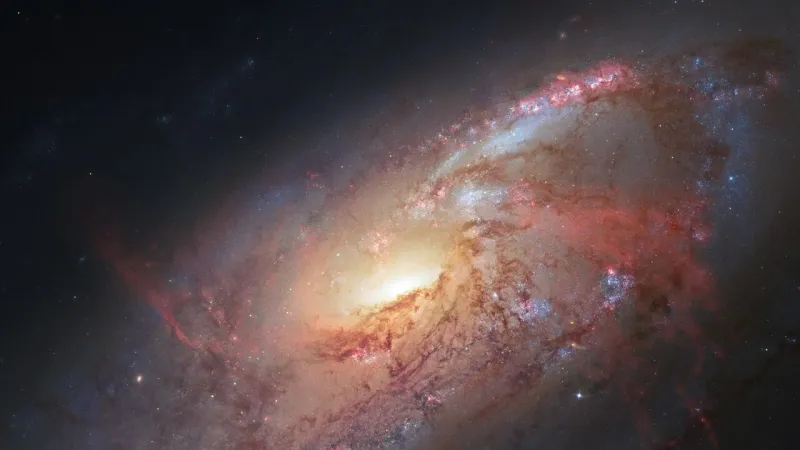
WASHINGTON – The Milky Way galaxy, our cosmic home, may have undergone a significant reorientation of its spin axis after a monumental collision with a smaller galaxy billions of years ago. This groundbreaking hypothesis emerges from advanced supercomputer simulations of similar galactic interactions, offering a fresh perspective on the dynamic evolution of our celestial neighborhood.
Astronomers have long understood that galaxies grow and change through mergers with other galaxies. However, the precise impact of these events on a galaxy's overall orientation and structure has remained a complex area of study until recently.
The research, which analyzed the gravitational dance and eventual merging of simulated galaxies, indicates that such encounters possess the power to dramatically alter a larger galaxy's spatial alignment. This rotational shift, akin to a cosmic tilt, could explain some perplexing features observed within the Milky Way today.
Scientists utilized high-performance computing to model scenarios where a massive disk galaxy like the Milky Way accretes a smaller satellite galaxy. These simulations tracked billions of particles under gravitational influence, providing unprecedented detail into the mechanics of galactic mergers.
The findings challenge conventional assumptions that the orientation of a large spiral galaxy remains relatively stable over cosmic timescales. Instead, the simulations propose a more volatile past, where the Milky Way's current tilt might be a direct consequence of a historical impact.
Such a collision would have perturbed the gravitational equilibrium, leading to a gradual but profound realignment of the entire galactic disk. The timeframe for this reorientation spans hundreds of millions to billions of years, a blink in the vast expanse of cosmic history.
Understanding these past dynamics is crucial for piecing together the Milky Way's full evolutionary narrative. It offers insights into how the disk formed, how stars are distributed, and even how our solar system came to reside in its current position relative to the galactic plane.
The methodology involved creating numerous hypothetical merger events, varying parameters such as the mass ratio of the colliding galaxies, their initial trajectories, and impact velocities. This allowed researchers to identify common outcomes and the conditions most likely to induce significant reorientation.
One key takeaway is that even relatively minor collisions, when occurring at specific angles and velocities, can exert substantial torque on a larger galaxy, forcing its rotational axis to shift over time. This effect becomes more pronounced with the cumulative influence of multiple smaller mergers.
Further observational data, particularly from missions mapping the three-dimensional velocities of stars within the Milky Way, will be vital in corroborating these simulation-based predictions. Advanced astronomical surveys continue to gather data that can help refine these models.
This research not only sheds light on the Milky Way's unique history but also contributes to a broader understanding of galaxy formation and evolution across the universe. It underscores the violent yet formative nature of cosmic interactions that shape the structures we observe today.
The implications extend beyond our own galaxy, providing a framework for analyzing the orientations of distant galaxies and inferring their past merger histories. This opens new avenues for exploring the cosmic web and its intricate dynamics.
Future studies will aim to integrate more complex astrophysical processes into these simulations, such as the role of dark matter halos and the impact of star formation and supernovae, to paint an even more comprehensive picture of galactic evolution.