 Chandra Wijayanto
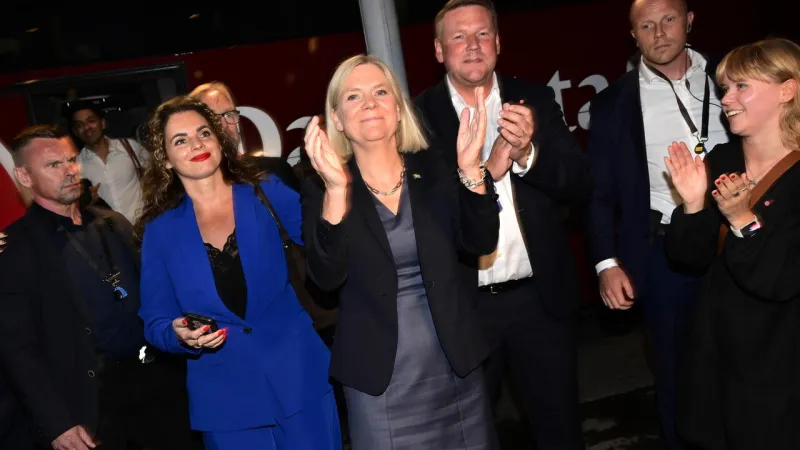
The STOCKHOLM political landscape is undergoing a dramatic realignment as Sweden's Social Democrats, under the leadership of Magdalena Andersson, appear poised for a decisive victory in the latest general election. This outcome heralds the probable conclusion of Prime Minister Ulf Kristersson's administration and delivers a notable setback to the far-right Sweden Democrats, led by Jimmie Akesson, whose influence had steadily grown in recent years.
Preliminary results indicate a robust performance by the center-left bloc, securing a plurality that positions them favorably for forming the next government. The shift represents a significant repudiation of the current right-wing coalition and its supporting parties, reflecting a nuanced public sentiment regarding the nation's direction.
Magdalena Andersson, who previously served as Prime Minister, appears set to reclaim the top political office, riding a wave of support for her party's traditional emphasis on social welfare, public services, and progressive environmental policies. Her campaign focused heavily on strengthening the welfare state and addressing economic inequalities.
Conversely, the Sweden Democrats, often seen as a bellwether for far-right movements across Europe, experienced a surprising dip in their electoral fortunes. While their exact final standing remains under scrutiny, the initial data suggests they have failed to expand, and in some areas, have lost ground compared to previous polls. This development will be closely watched by political observers beyond Sweden's borders.
The election results underscore a potential re-evaluation by Swedish voters concerning alliances between mainstream conservative parties and the far-right. Ulf Kristersson's Moderate Party had relied on the Sweden Democrats for parliamentary support, a partnership that drew criticism both domestically and internationally.
Analysts are now dissecting the factors contributing to this electoral pivot. Issues such as the economy, national security in a turbulent global climate, and the future of Sweden's social model likely played pivotal roles in swaying voters. Public discourse during the campaign often centered on these crucial themes.
This anticipated victory for the Social Democrats marks a critical moment for Swedish politics, suggesting a potential return to more traditional political alignments after a period of increasing fragmentation. The ability of Andersson's party to consolidate support across various demographics proved instrumental.
The performance of Sweden's center-left stands in contrast to recent trends observed in other European nations where far-right parties have continued to gain traction. This particular Sweden election could thus offer valuable insights into the dynamics of political resilience and the electorate's shifting priorities.
Jimmie Akesson's party, which had leveraged concerns over immigration and crime to expand its base, now faces the challenge of re-evaluating its strategy in the wake of this apparent electoral stagnation. The narrative of inevitable far-right ascent may need revision in the Swedish context.
Forming a stable government will be the immediate challenge for Magdalena Andersson. Sweden's multi-party system often necessitates intricate negotiations and broad compromises to secure a parliamentary majority. Her experience in past coalition-building efforts will be crucial.
The international community, particularly within the European Union, will closely monitor the policy implications of a new Swedish government. Sweden's voice on issues ranging from climate change to security alliances holds significant weight on the continental stage.
This political shift could also influence Sweden's approach to its NATO membership, a recent and historic development. While consensus on NATO is strong, a change in government leadership might subtly reorient diplomatic priorities or approaches to alliance contributions.
For Ulf Kristersson, the election outcome represents a personal and political blow. His tenure, though relatively short, saw Sweden navigate complex geopolitical challenges and domestic economic pressures. The Moderate Party will now need to assess its future direction from the opposition benches.
The perceived retreat of the far-right in a prominent European nation like Sweden may embolden centrist and left-leaning parties elsewhere to scrutinize their own strategies for counteracting populist narratives. The outcome offers a glimmer of hope for those advocating for more inclusive political agendas.
Looking ahead, the new Swedish government under Magdalena Andersson will inherit a complex array of domestic and international files. Addressing cost-of-living concerns, bolstering public services, and maintaining national security will undoubtedly top the agenda. The path forward demands deft political navigation.
The country now awaits the final, certified results and the subsequent process of government formation, which promises to be a period of intense political bargaining. The era of Ulf Kristersson appears to be drawing to a close, paving the way for a renewed center-left leadership in Stockholm.